Back in Boston: Conclusion

April 21st, 2008

So what are my final thoughts on my trip to Boston? I left the city with a mix of feelings. On one hand I am happy the city looks so good, lots of new buildings and stores, neighborhoods cleaning up. Most of the people I met weren’t cold mass holes like I thought they would be. The T seems to be getting on the right track, finally. But something didn’t feel right. Maybe I am too used to New York, though, interestingly I didn’t miss New York at all while in Boston. Coming home didn’t feel like coming home, just like I was moving from point A to point B.

Boston was described by a geography friend of mine as a “baby city”. I’m sure no one in Boston would feel that way but coming from New York it is easy to see how you could look at Boston like a baby city. Boston was comfortable. It wasn’t noisy, the streets weren’t filled with a sea of people (in some places they were but it wasn’t a rush, more like a slow crawl where people were stopping to see the sights.) It was also clean, which I don’t think I would ever say had I not lived in New York. Or maybe that just speaks to how dirty New York is (it is, but that’s how we like it, isn’t it?)

I came up for the Geography Conference but only went to a couple of seminars and blew the whole thing off for most of the week. I really came up to hang out and walk around and that’s what I did. But I came to Boston with the idea in my head that I knew what I was doing with my life, that I had a path and I could see the end of it. I come back to New York questioning what it is I really want to do. I still want to do Urban Planning, I think, but the closer I come to graduation the less I know what that means. Maybe I just got a giant dose of academia and realized that that wasn’t what I wanted, though I think I already knew that.

I remember when I was a kid, I was totally obsessed with dinosaurs and I knew I wanted to be an archaeologist when I grew up. Soon that passed and what I wanted was to be was an astronaut. Space was my life. But then I grew out of that too. When I first went to college I went for Industrial Design, and though I don’t think I ever wanted to do that professionally, I knew design would play a big part in my life. I remember the day a professor recommended urban planning as a major, since I was very interested in the city and very much not interested in designing products. The more I learned about it the more I liked the idea. But always in the back of my head I remembered the times when I was truly passionate about something else, only to wake up one day and lose total interest. It scared me that this would happen again some day when it would actually matter. As a kid you can think you want to be whatever but when you grow up and need to find a job, having fleeting passions isn’t going to work out when you need to pay the bills.

But perhaps that was the problem, that Boston was my passion all along. I kept up the T website and would look longingly at maps of Boston, remembering the great times I had there and remembering how it sparked my interest in cities. Maybe going back was what I needed to realize that that was the wrong direction, that I left the city because there wasn’t anything there for me and there still isn’t. Maybe this is the city telling me to move forward, to focus on the new possibilities in New York and in greater cities still. Perhaps the reason I am so conflicted is because I was looking for something that wasn’t there, something that I only remember, and that may have not even really existed in the first place. I think I finally saw Boston as an outsider and it shook me up. Maybe this was the world’s way of saying keep your eye on the prize and don’t look back.

I remember walking down Centre St in JP to the Orange Line to get to Back Bay and I thought I heard someone call my name. I looked back but I didn’t see anyone, but as I was doing this an image of Lot’s wife flashed in front of my eyes as she looked back on her burning home, only to be instantly turned into a pillar of salt. I turned back around, thinking that if I kept looking back I too would transform into a pillar, a monument to all that I have left behind. I think that is the fatal flaw of Boston, that it recognizes and fetishists it’s past, looking back longingly to an era that was perceived as being greater, but in reality wasn’t. The city cannot get past the past, and that is something I cannot do.

Here is a map of all the places I walked last week, some with links to images I took on my Flickr page.


View Larger Map

Back in Boston: Part 5

April 18th, 2008

Jamaica Plain

The only time I’ve been through JP was when I rode my bike along the Emerald Necklace and ended up in Mattapan. I don’t remember much of the area other than the parks so I figured if I was staying here I should explore it a bit.

JP isn’t as big as I thought it was. It was a streetcar suburb and as such is very walkable. It is mostly residential, even along the commercial areas. What I like about JP is the variety of housing. There are streets with single family houses, duplexes, triple-deckers, apartment buildings, and even a mansion thrown in here and there. Parts reminded me of Arlington, where I grew up.

There are sections of Jamaica Plain that are very hilly and this is where some of the older, more interesting buildings are. There are hills with large lots on the top with a single mansion, usually painted some dark green color, with mansard roofs and dark windows, surrounded by very large and very old trees. This is the type of neighborhood where horror stories are set, street after street of Houses of Usher.

Like I said, this is in the older section of JP. When you come down off the hills there are smaller houses, but just as odd. The area was home to a number of factories and workers homes since this was one of the first areas in Boston to gain a railroad. Most of the factories are gone, though some buildings remain, usually on the other side of the tracks, the Roxbury side.

Today the Orange Line makes all the stops the B&P used to while the commuter rail whizzes by to serve communities further out. Because land was originally cleared for a highway up this way there are still some abandoned lots near the Orange Line along with the parks of the Southwest Corridor. This gives commuting to and from JP an interesting feel. Living in New York, when you get off a subway station, you get off in a city, a dense neighborhood with retail and residences all mixed in. When you get off the Orange Line stations you get off into a suburb. There is a large park and across the street are wooden houses, with a small shop but not much else. Because there is also no parking you don’t get the sense that you are in a modern park-&-ride facility far out in the suburbs, but that you are in a real place.

On the other side of Centre St are more houses, though because this is the area of Jamaica Plain that is actually flat, the streets are straighter and the houses are more similar, though just as interesting. If the last section of JP reminded me of Arlington Heights then this reminds me of East Arlington. I realize that most people reading this will not understand what I mean so I will explain:

Geographically, Boston lies in an area known as the Boston Depression, a low area surrounded on 3 sides by large hills. This was created when a massive glacier sat atop the area now known as Boston, literally depressing the land. If you go to the observation deck in the Prudential Building and look at the horizon you will see hills on three sides, with the ocean on the fourth. This geographical phenomenon is most responsible for shaping the growth of the city. It defines where the roads and railroads where built and where the poorer areas and wealthier areas were built (poorer areas are typically in low lying areas while wealthier areas are built on high ground, though this isn’t always the case).

Arlington is a town that is built with one side on the escarpment that rings Boston and the other inside the depression. Because of this, the area known as Arlington Heights has a more natural road pattern (winding roads that follow the contours of the hills) while East Arlington has your standard grid pattern. The houses on the Heights are usually bigger and more expensive while the houses in the East are more uniform and less expensive. I see the same pattern in JP, with the exception of larger houses along the edge of the neighborhood along the Jamaicaway, the section of the Emerald Necklace home to Jamaica Pond.

Another thing I noticed walking around the older section is that the streets are very narrow, as are the sidewalks. This gives the feeling of walking in the North End or a European village. It’s a nice change of pace.

At the very end of JP lies the Arborway, a landscaped parkway running from Jamaica Pond to the Arnold Arboretum, a tree museum. The Arborway is a fantastic example of a time when cars were only owned by the rich and only went 20mph. There are giant tree lined rotaries that feed into a parkway with 8 lanes, 2 side lanes with large tree lined medians and a 4 lane road in the middle. It is a prime example of how engineering and landscape architecture can come together and make an simple infrastructure project a work of art.
I didn’t get to go into the Arboretum this time around, though I’ve been in there once before and it is a magical place. The old saying is “You can’t see the forest for the trees” but here is a place that is designed to address that.

Running down the center of JP is Centre St. The first thing one notices is the old trolley tracks that still run in parts of the street. The E branch used to run all the way through JP to Forest Hills but was scaled back to Heath St in the 1980s when the Southwest Corridor Orange Line opened up. Various community groups had been pushing for the restoration of service, now handled by the #39 bus, but resistance from city hall and the pull out from one of the more important backers, the Conservation Law Foundation, had made it very unlikely that service will ever return.

Back in Boston: Part 4

April 17th, 2008

Back Bay and Beacon Hill

I am not an early riser. This, combined with going out every night, means that I have been missing a number of presentations I wanted to see, but I’m not concerned with this since I’m finding this whole conference a bit too academic for my tastes. I met up with my geographer friend Stef at the official conference party, complete with open bar and 80s cover band. When I got there everyone was standing around the dance floor, not dancing. At one point the singer said “Do geographers know how to party?” From the response the answer to that question is a definitive no.

I want to give a shout out to CJ Bright and Rebecca Alper. CJ did his presentation on the Silver Line BUS and seemed quite surprised when I dropped the bomb by telling him who I was. Rebecca did her presentation on property values in relation to the E branch street car of the Green Line verses the #39 bus. She found that property values were unaffected whether the transportation was via streetcar or bus. Interesting findings that may make people reevaluate the fight to bring back the Arborway trolley.

I left the conference and was about to go home when I realized it was an absolutely beautiful day out so I just started to wander. I checked out the construction site for the Columbus Center. What a clusterfuck that has been. I’m not going to go into now but lets just say they just dug everything up and it looks like it is going to stay dug up with nothing being built for a while. I wandered around the Back Bay, not really having any real place to go. I made my way into the Public Gardens and onto the Common. This was one of the first warm days this spring in Boston and everybody was out.

I met up with Stef and we got some food and ate it on the monument on the top of the hill in the Common. We were hemmed in on both sides by two separate groups of kids smoking pot so we left. I showed her Beacon Hill and where John Kerry lives. She is short so we took a bunch of pictures inside those crazy tiny doorways they used for coal deliveries back in the day and took pictures inside those Dickensian alleyways that are all over the Hill.

We then went to check out the Hurley Building, a Paul Rudolph building where parts of The Departed were filmed. This is one of the most amazing buildings in the world but lack of respect and investment are showing their signs. The concrete is falling apart and the plazas, which are used as parking, are in terrible shape. We got lost walking down a set of stairs that go nowhere and ran into a guy rolling a joint who gave us directions on how to get out of there. If weed is illegal you wouldn’t know it here.

We ended our trip through the Bulfinch Triangle. I love the old warehouses here. This area could totally be Boston’s TriBeCa (think about it, it is literally the Triangle Below Canal St, more so than TriBeCa in NYC) but its proximity to the Garden will probably forever relegate it to the domain of drunken Celtics and Bruins fans.

Back in Boston: Part 3

April 15th, 2008

This post is the second half of my walkabout from yesterday.

Part 3: Lechmere and Kendall Sq

I took the T from North Station to Lechmere to see some of the new construction that has gone on over the last two years, notably Northpoint and Archstone-Smith. Archstone-Smith is gorgeous and towers over the neighborhood, but because it is set back behind the highway and T line it doesn’t overpower the small residential streets of Lechmere. I would describe it as post-modern art deco. The top reminded me of the tower of the Landmark Center in the Fenway, only made out of colored glass. I think the image on the website has been shrunk down or Photoshoped to make the building appear less tall. In reality it is massive, almost like the giant housing complexes you find in Hong Kong.

The story of Northpoint is a sad one. The area in question is prime real estate if there ever was. Located next to two T stations, a highway (set back enough not to hurt property values), abutting new parks built along the Charles River, and a stones throw to North Station, Northpoint should have been Boston’s answer to Battery Park City in Lower Manhattan. The land used to be train yards and lay abandoned for decades. About 10 years ago developers started putting together a proposal to build a mini city there, complete with housing, office space, lab space, and a new T station that would be built to allow for the Green Line extension to West Medford (whenever the state gets around to that). The land was cleared and a couple of buildings started to go up when the developers got pissed off at one another and started suing. They finished two of the residential units and they are now open, which if you like living in a sand pit is great.

What is most depressing is what has been built is seriously nice. The quality of the design and the materials used are top notch and the townhouse design is ultra modern. The buildings are not overwhelming and have these great elevated front yards that you walk up to. They are even installing a playground in the front yard area. It will be a real shame if all that is ever built of this project are these two buildings.

Next I moved into Lechmere proper. I’m not sure most Bostonians have ever actually been to Lechmere. Sure they have been to Cambridgeside or have seen it on the T map, but I’m sure most people have never taken the time to walk around this quiet working class neighborhood. Stepping off the T you come to OneFirst, a huge residential complex recently finished that combines old industrial warehouses with new construction. I have to say this has proved to me that you can be modern and still not need to build huge extroverted boxes that impose themselves on a neighborhood. Instead of building one giant building, the developers built a number of different looking buildings that all relate to the streets they are on. The buildings on Cambridge St are 6 stories and have retail on the first floor, while the buildings on quiet side street off Cambridge step down to the lower scale and change design to fit in with the rowhouses along the 2nd St. So perfectly did they do this that I didn’t realized what I was looking at was new construction until I took a closer look. I could go on about this complex but it would just be more of the same flattery.

I had worked a temp job at one point in Lechmere the summer before I moved to New York and I happened upon the offices on this walk. I initially didn’t recognize the place because across the street were a series of townhouses that I had never seen before and were so perfect at recreating the colonial period that you find in the older parts of Cambridge that I wasn’t sure they were even modern until I saw the garages in the back. They say make no small plans but these infill developments have inspired me more than the new 1,000 ft tower the mayor wants to build, or Harvard’s total renewal of Allston.

Kendall Sq is changing fast as well. Before I moved, Genzime had just put up their award winning headquarters and there was talk of building some condos in the area. The area just north of Kendall Sq is a sandbox; the condos are going up looking classy and modern, a number of new lab facilities have gone up and are going up, and I stumbled upon a new police station that blew me away. It had these great metal (probably aluminum) details, but used brinck and granite for the faciade. The brick work was interesting and distinctive and the windows were tall with quality frames. I’ve seen so many cheap ugly condos going up in Manhattan and Brooklyn that I forgot what good construction looked like.

I headed off to Harvard Sq where I usually seem to end up anytime I’m in Boston. Some of the stores have changed but most of the square hasn’t. I went into the Harvard Coop and ran into a few people I had worked with 3 years ago; I’m sure that made them feel fantastic for lasting that long (I worked there a year). I picked up a copy of Italio Calvino’s Invisible Cities which I first read down in the break room there. Outside while waiting for Ian I ran into a young woman who I had worked with the day before at the AAG conference. She was from China which made the encounter interesting because we were standing right next to a group of pro-Tibet protesters in the Pit.

That night I went back to Arlington for the first time since I had moved. A few things have changed but not much (the town is no longer dry). Ian and I drove around and he pointed out little things that had changed and we talked about old times. It never hit me how suburban the town is. I always considered it more urban than most suburbs but now after living in New York the place seems like a grave yard. It was only 8:30 but there was no one out, the place was a ghost town. I guess I never noticed it before.

Back in Boston: Part 2

April 14th, 2008

I came back to Boston to walk around and let no man say that I did not fulfill my wantings.
I walked in three sections and you can see my routes by clicking on the section titles.

Part 1: JP to Back Bay

I started by walking back up South Huntington Ave and Huntington Ave to get some pictures of some interesting buildings I had seen the day before. The sun was shining bright but was ducking behind clouds now and then which was frustrating when trying to line up a shot only to have the sun move behind a cloud when I took the picture.

Off Brigham Circle there are two streets I used to love walking down when I went to WIT, Wigglesworth St and Worthington St (word to awesome British names). Most of the housing around Mission Hill are either ugly modern high rises or tired old triple-deckers. These two streets, and only these two streets, are lined with stately and handsome townhouses that look like they were picked up from the South End and planted down on the other end of town.

Further down Huntington Ave I walked around the campus of WIT. I cannot believe I went there, not because it was a bad school but because I could never see myself fitting into the townie-frat boy crowd there (I have changed since I went there but I still cannot see my past self there). I guess that’s why I left. I have seen a lot of change and a lot of places in the 4 years since I left WIT but the place and the people look timeless (about 2001).

I turned down Ruggles St to check out a new dorm being built by Northeastern next to the Ruggles Orange Line station on Columbus Ave, a stretch of highway with a park on one side and an empty lot on the other. This area was where acres of land was cleared in the 1960s to build a gigantic interchange for two highways that thankfully were never built. The new Orange Line and Southwest Corridor park system were supposed to help bring back the area, but the basic laws of real estate still applied (location, location, location) and the “neighborhood” is now only comprised of housing projects and a large police station.
The new dorm is horrendous. It is completely out of scale with the area, though when the area only has a couple of short buildings surrounded by fields being out of scale isn’t much of an issue. The main problem is the use of precast concrete panels that are painted to look like brick and already suffering from water damage despite the building being nowhere near complete. The projects across the street are literally nicer and in better condition. Northeastern has been building new dorms on the Huntington Ave side of the tracks for years and they have always been attractive and well built. I guess this shows what the university thinks of it’s poor neighbors.

I next walked down Tremont St heading north. The South End has two parts; the area above Mass Ave (the gentrified area full of artists and gays), and the land south of Mass Ave (projects, abandoned lots, a highway, and then what’s left of Dudley Sq.) If you stand at Mass Ave you can see the difference clearly when you look north and then south. I had never ventured south of Mass Ave so walking up Tremont St seemed like something I needed to do to get the full South End experience.
What I found is an area that shows signs of life despite extreme social issues. Tremont St is lined with old walk ups next to new or newish affordable housing. The side streets are a mix of old school low-rise projects next to new affordable housing that you probably wouldn’t think where projects unless someone told you. The streets where still sterile and devoid of life since it seemed that this was new housing, though I think this is the result of the new approach to dealing with failed projects; rip them down and put up mixed income housing. Will it work? Time will tell.

Up on Mass Ave you come to the area where the wealthy elite of Boston first built their mansions and townhouses, only to abandon them for the even more luxurious Back Bay. I made a quick detour up Mass Ave to inspect an infill project I had read about. It was very nice, contextual with red brick but modern in form. I especially liked the tall thin windows it used. I have a huge issues with most windows used in standard housing construction nowadays. I find them short and fat, not unlike the average American. This building, along with the new housing I had just seen, proved that you can work within the urban row house context and still be modern and interesting.

I made my way up Columbus Ave, which at this point is lined with stately brownstones that look straight out of Fort Green or Park Slope in Brooklyn. Most have first floor additions that are now funky retail stores, signs that I am now in YUPy territory. I weaved my way down side streets between Tremont and Columbus, admiring the variety of houses along quiet streets designed along the lines of London Squares; a median of elegant trees and rainbows of flowers running down the center of the street.
I walked down Warren Ave and turned on to Dartmouth St. Here I took another detour to explore Tent City. Tent City is an affordable housing development built after some Boston residents protested the lack of affordable housing in the city by setting up a tent city on cleared land across the street from Back Bay Station. The development is notable because it gracefully transitions from the low rise South End to the skyscraper canyons on the Back Bay. It also was one of the first post-modern housing developments that used contextual architectural elements instead of being just another brick box (a number of these bring boxes line Tremont St and Cloumbus Ave which seriously clash with the highly detailed townhouses.)

I walked down to the Prudential Center to see the new Mandarin Oriental hotel going up. I still don’t know how I feel about it. The massing is nice but I think the details are far too sparse for a building in such a prominent location. I think something like the Hotel Chelsea in Manhattan would be more appropriate; Gothic elements or perhaps a darker colored brick.

I hopped on the Green Line at Hynes and made my way to Park St for lunch. I never realized how spacious the Green Line stations are in the Back Bay. The arched ceilings give them the feeling of an asp in a modest cathedral. I don’t think a Bostonian would ever, EVER, think of a T station like a cathedral but seeing them after being used to New York station with their low ceilings and dark interiors makes the T stations feel much less oppressive.

Part 2: Downtown Crossing, Government Center, and the North End Parks

One of the most exciting areas in Boston, IMO, is Downtown Crossing. Once the Herald Sq of Boston (Macy’s and Gimbels vs Filene’s and Jordan Mash), DTX fell on hard times when people began to move out to the suburbs and the retail followed. In the 1970s and 80s the area was known as the Combat Zone, high crime and a flourishing sex industry pushed out anyone who hadn’t left for the suburbs. Through intense community activism and help from City Hall the area was slowly cleaned up and became a bustling retail crossroads once again. But when a number of key anchor tenants, Barns & Noble and HMV, left the area started to falter. Then Macy’s bought Filene’s and decided to close the original Filene’s (which just happened to be across the street from Macy’s).

Over the last 7 years the city has pushed to revitalize the area. A number of new condo towers have gone up, along with new hotels and office towers, which has helped bring more street life to the area. Suffolk University and Emmerson College have begun fixing up old theaters and converting abandoned buildings into dorms. Two buildings currently under construction, 45 Province St and One Franklin, a new tower going up on the site of the former Filene’s building (though incorporating the historic building in the new tower) has me most fired up for the revitalization of DTX.

From here I explored the area a little bit, not knowing where I really wanted to go. I made my way up to City Hall and realizing I had never actually been inside, decided to check it out. The metal detector guy noticed my camera in my bag going through the machine and commented on how nice it was. The first thing that struck me was how open the building was. From the outside it looks like a huge bunker but inside it is light and airy with natural light coming in all over the place. No wonder it is a bitch to heat and cool. The doors to the courtyard were closed and the security check point gave the building even more of a fortress like feeling than the building already has. Still I think it is gorgeous and in desperate need for a modern makeover.
I had heard there was a giant model of downtown Boston up in the Boston Redevelopment Authority office so I went up to see if I could get in to see it. The receptionist told me I needed to have someone open the room for me but she couldn’t find the person with the key so she just sent me down the hall (seriously, I think they are far too trusting to send a scruffy hipster kid down through their offices unescorted). The door to the model room was closed but if you’ve ever seen Indiana Jones and the Raiders of the Lost Ark, it kinda looked like that room Indy goes into to find the real burial spot of the Ark. The lights weren’t on so the models of the towers were back lit by the sunlight coming in from the window. Mayor Menino has proposed building a 1,000 ft tall tower in the Financial District and the model for the tower commands the entire room (which is saying a lot when you have a room sized model of every building in downtown Boston). I immediately realized that if this building was ever constructed it would be the Prudential Building 2.0 and we would all regret it. The tower fails for the same reason all modern buildings do, it looks great as a conceptual model that an architect can show a person powerful enough to get it built. I went back down the hall, picked up some info on the BRA and internships and headed out.

I next headed to see the new North End Parks built after the Big Dig. I had seen the Chinatown and Financial District Parks (not very inspiring) but hadn’t seen these. Right off the bat I noticed a huge design flaw; the parks where elevated (due to the presence of highway off ramps below them) which blocks a pedestrians ability to see users of the parks. All you see walking down the street is a wall of shrubbery. Above, on the parks, there are nice lawns where you can sunbathe or play games, along with a promenade under a pergola which will actually be very nice in the summer time.

The old Central Artery was described as a giant gash cutting though the city. To take the analogy further, the new parks are very much like a giant scar. The newly planted grass and trees represent a scab. The area still feels disconnected from the rest of the city, but like all wounds, will heal in time. Buildings will be built around the parks to connect the city and bring in people, and the plantings will evolve and mature. The scar will remain but the wound will heal.

Up at North Station you can just start to see the wound healing. A new mixed use apartment building is going up where once an elevated train track ran. The lots next to it are barren, awaiting brighter economic conditions, but the streets are laid and the lamps are in. The Bullfinch Triangle will soon be repaired.

I hopped on the T to head over to Lechmere and on to Kendall Sq.

Part 3 and the rest of my journey tomorrow.

Back in Boston: Part 1

April 13th, 2008

I’m staying with my best friend from high school, Ian. He now lives in Jamaica Plain, near Hyde Sq. He told me to take the Orange Line to Jackson Sq, which I was a little apprehensive about since the last time I checked that was one of the more dangerous areas along the T.

The first thing I noticed was how much the T had changed. When I left Boston in 2006 there was much to be desired. LCD signs that had never worked or would only ever tell you not to smoke, and station announcements that told you nothing about your next train, not that you could hear them in the first place. Welcome to the future, Boston, or at least at the Back Bay station, as you can imagine how surprised I was to see an LCD sign that worked and announcements that told you 1) if there were any delays AND why and 2) when a train was coming. Also there is mad signage about different bus lines you can connect to (which they always had but where hard to find), info on the new fares, and system maps that actually showed the current system, not the system in 1990. Way to go Dan G. The Charlie Card system is nice too, I had used it once before but this was back when it was only at a few stations which meant you had to buy a ticket AND a token.

I met up with Ian and went back to his apartment. I had only been through Jackson Sq once while riding my bike, maybe 5 years ago. I stopped to figure out where I was and kept moving. Centre St is a lot more cleaned up nowadays. I always knew JP was gentrifying but I didn’t imagine how much had changed since the last time I’d been though.

I had to work today at the Marriott in Copley Sq, stuffing bags for the conference for 8 hours. It sucked but I am now done volunteering (they only allowed you 8 hours) and now have the rest of the week to see and do what I wanted. If I was smarter I probably would have just hopped on the Orange Line and gone back to Ian’s place for a long nap, but I am not.

When I first went to college in Boston it was at Wentworth Institute of Technology which is located on Huntington Ave in Boston’s Fenway neighborhood. I didn’t so much love the school as I did the area. I have fond memories of walking around the Fens, going to parties on Mission Hill, and learning photography by taking pictures of the apartment buildings and old townhouses that are prevalent in the area. The place was originally built as an urban suburb for upper middle class Bostonians around the new Fenway, a park system that was ingeniously designed by Frederick Law Olmsted to store flood water from the Muddy River and Stony Brook. Like all posh neighborhoods everywhere, the upper middle class soon moved out to greener pastures, leaving the area to fall into decay. The thing that saved it was the multitude of colleges, universities, and institutions that call the Fenway home. Today almost all of these once fashionable dwellings are home to fraternities and dorms.

As I walked down Huntington from the Prudential Center I didn’t really notice anything new. The area around Northeastern was quiet with only a few students walking around. It was Sunday afternoon so I didn’t expect it to be the crazy hurricane of class-bound youth it usually is. One thing that did catch my eye was a new dorm that had been built right before I left WIT. I had seen it many times but this time it seemed smaller to me. How odd I thought. The MFA is currently constructing a new wing, which is always something that they were promoting when I lived next door to it but never thought they would actually raise the cash for. Apparently the Isabella Stewart Gardner Museum is too, which even though I lived across the street I have never been to. Mental note…

When I left WIT, the Institute was in the process of vastly expanding it’s campus, first by building a series of dorms, and then eventually a few new academic buildings. They had a dorm under construction when I left and I never got to see it completed. It looks really nice. It is post-modern and contextual with many small details that relate to the old apartment buildings in the area. I thought it was going to look cheap when I saw pictures but it fits in well.

Further up the street I noticed things starting to change. WIT had purchased two gas stations next to their dorms and demolished them. They occupy small triangular lots which will make any new buildings on them interesting by default. There used to be this funky little diner/bar on the corner of Longwood and Huntington that we always walked by on our way to parties/Stop & Shop. It had this great mural on it of I think a jazz performance, along with some graffiti. It added a little bit of urban flavor to the area, which was known for being one of the roughest places in Boston. This now is a newly refurbished office which you would think new if you had not seen the old building.

I remember this stretch of Huntington in my mind as almost noir, dark and dirty, a place we would go because they had liquor stores that usually didn’t card, vacant storefronts, and dark figures walking down the street that you tried to avoid making any kind of contact with. Today Brigham Circle is almost clean, and hip. New stores with neon colored signs line the street; new diners and pizza joints. The area was beginning to gentrify when I was there and it looks like the college kids finally took it over.

Further down the way things start to get a little dirty again, but not for long. New condos are going up and old apartments and triple-deckers are starting to go that way too. The low income housing development know as Back-of-the-Hill, an ugly 80s era brick monstrosity, is being redone in a very contemporary way, which in 20 years will be seen as a monstrosity once again.

I had forgotten how much I love Jamaica Plain. The way it sits on this hill above the Muddy River, the way the light hits the funky houses, the beautiful old triple-deckers and single family homes that the same upper-middle class moved to from areas like the Fenway when street cars allowed them to flee to the suburbs. The houses are cared for and the streets are quiet. JP was, in my mind, always hip. I used to come here for parties in high school, much like I got parties in Bushwick today, and both had that feeling of “sluming it”. I hadn’t walked through it since some time in 2003 when some friends in the Industrial Design program at WIT thought there was a hardware store there with some obscure supply we needed (IIRC they didn’t have it.) The area is very much like Medford or Arlington. There are areas where there are mansions as well, though I didn’t walk past them tonight.

I crested the hill as the sun was setting. I have become so accustomed to the strong light in New York City that I had forgotten how soft and special it can be on a quiet Sunday in Boston. It brought back memories of driving around with my dad, maybe out in Brookline or through Arlington, Medford, and even Revere. It was a comforting feeling, the light a light blue with yellow-orangey highlights on the slowly moving clouds. A storm was passing which in one direction looked dark gray but in the other looked pastel. There wasn’t much traffic and the amount that was there fell into the background as all the memories of walking down this same street, and of the many others, came rushing back. This is why I made this trip.

Back in Boston: Introduction

April 13th, 2008

I moved to New York in the summer of 2006 to attend Hunter College. I chose Hunter and New York because after 6 years in Boston I felt that the city had shown me everything it could and it was time for me to move on. I moved at the same time as my good friend Andy, who I met when we both worked at the Harvard Coop bookstore in Harvard Sq. He lived in Medford and we used to enjoy exploring different neighborhoods in the Boston area. He now lives in Astoria, Queens and I in Manhattan. We still like to explore the city but we also reminisce about our times walking around Boston.

I’d been back to Boston twice since I moved, both times while on a holiday at my relatives who live in Plymouth, and only for less then a day. I would try to hit up some old spots and check out new buildings that I had read about but I never really got to enjoy myself. I missed the long quiet walks through Boston’s unique neighborhoods. I decided to find some time to come back to the city for a little vacation but school, job(s), and life always got in the way.

Last January I got an email from a friend at Hunter about the national American Association of Geographers (AAG) conference which was being held in Boston. Bingo, perfect opportunity. The conference is this week and if you volunteer they reimburse you for half of the registration fee and pay you for your work, which means a conference that would cost me $195 will only end up costing about $40. Boosh.

So for this week I will be posting my thoughts on seeing my old city with new eyes and in new times. 2 and 1/2 years doesn’t seem like a long time but a lot can and has changed. I won’t be posting any pictures but I will be taking many and when I get home I’ll put a whole bunch up on the Flickr. I’ll also post about anything interesting I learn at the AAG conference.

Blue Line update

August 6th, 2007

Moving along (slowly) with my overhaul of the Future MBTA section, tonight I updated the Blue Line with two new maps and a whole new write up.

Unbuilt Highways

July 11th, 2007

Google Maps recently added a new feature where you can create your own maps and needless to say it is pretty awesome. They are great for making a quick map for someone to show them how to get some place but they are also great for the type of stuff I do. After playing around with it I came up with three maps, all unbuilt highways for Albany NY, New York City, and Boston. Whats even better is that you can download these maps and view them in Google Earth by clicking on the KLM button on the top right.

The first map I made was the unbuilt highways in Albany, NY. These were based on information from Capital Highways, a web site about highways in upstate New York. There are a number of large interchanges with ramps to no-where in Albany and this explains what happened to them. The blue line represents the Mid-Crosstown Arterial which would have cut straight through the heart of Albany and Washington Park. I-678 which would have bypassed the interchange of I-87 and I-90 in Colonie and gone directly to Albany International Airport. This off ramp is all that was ever built of the highway, which now serves as a connection to an office park. Finally the red line represents what would have been a spur off of I-90 through Rensselaer and connected with the Dunn Memorial Bridge. You can see where the bridge stops in mid-air here, where it would have continued east to connect with I-90.

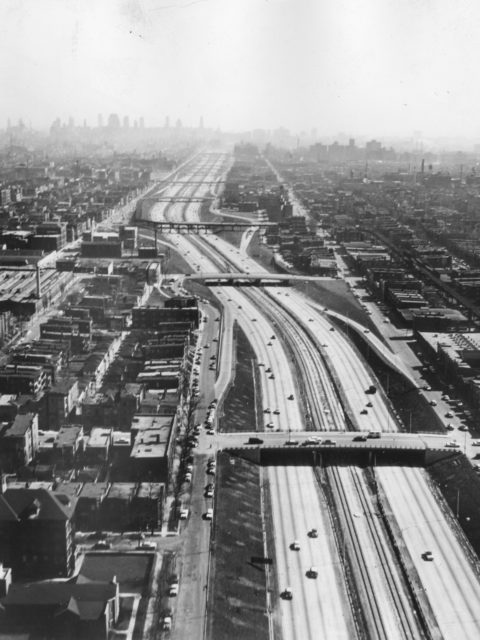
The next map was for Boston, MA. In the Future MBTA section for the Orange Line I talk about how the current Orange Line was built in land cleared for the extension of I-95 into Boston. Here you can see what I was talking about along with the other highways that were to plow through the city. This map was based on information from Boston’s Canceled Highways. The red line represents I-95, both the northern section that would have run through Lynn Woods and the southern section which would have run through Hyde Park and Roxbury. The green line represents I-695, or the Inner Belt which would have ripped through Cambridge and Roxbury, almost completely leveling Cambridgeport for a gigantic interchange at the Mass Pike. You can see the remnants of the highway here where there are dead off ramps off of I-93 (and there is also a road called Innerbelt Road) and here, which was turned into Melnea Cass Boulevard. The yellow line represents Route 2, which today ends abruptly at Alewife but was supposed to carry on further into Cambridge. The blue and purple line represent Route 3 and an elevated relocation of the Mystic Valley Parkway, respectively. You can see the unbuilt portion of Route 3 at the interchange at Route 128. Each would have destroyed the picturesque, tree lined parkway that exists today.

The last map I made was for New York, NY. These are based off of the unbuilt highways section of NYCRoads.com, which is a fantastic resource. Not all of these were Robert Moses highways but many, such as the bridges across Long Island Sound, were. Some were merely ideas for expanding roads rather than actually building new highways, of which Queens Boulevard is a good example. There are far too many for me to talk about here but if you click on the road you will see information about it and a link the it’s page on NYCRoads.com.

Edit: I have now added these maps to this site, check out the Unbuilt Highways section for these and more.

Future MBTA Updates

June 14th, 2007

I am finally getting around to update the Future MBTA section of this website. I have created all new maps, ones that show the entire region, ones that show possible extensions for certain areas, and even a giant Commuter Rail map. I also have changed the background maps from the state satellite images to the Google Maps map. They are not interactive though, still working on that. I have also moved all my images off to Flickr to save bandwidth and prevent image leeching. I have rewritten the Red Line page and will rewrite most of the other pages in time. I also hope to actually write a full page on the Urban Ring proposals rather than the brief overview I threw up there a long time ago.