The futureNYCSubway: Queens-Flushing Trunk Line

Wednesday, June 2nd, 2010

Introduction

Jackson Heights, Queens under development in 1924.

Jackson Heights, Queens under development in 1924. The Corona Line (7 train) Subway is seen running east at the bottom.

The borough of Queens came late to rapid transit development. Even after Queens was created out of Nassau County when New York City consolidated into five boroughs it remained farmland well past World War II. Some areas did grow thanks to the introduction of railroads, the Rockaways had summer resort communities.  Some early railroads cut through Queens to serve already established towns like Flushing and Jamaica and some were built as real estate ventures that went bust, but by the turn of the 20th Century all of these had been consolidated into the Long Island Railroad or been abandoned. Queens began to develop after transportation improved with the opening of the Queensborough/59th St Bridge and the construction of the Steinway or Belmont Tunnel which allowed elevated and subway trains to be built to Astoria and Corona. A well repeated fact is that the first radio advertisement ever was for new garden apartments in Jackson Heights which were built after the Corona Subway (todays Flushing 7 Line) opened up the countryside.

Planners knew that Queens would eventually grow with development and as neighborhoods like Jackson Heights and Forest Hills began to pop up the need for improved rapid transit also grew. When the city built the IND Queens Line along Queens Boulevard it was designed to be the major trunk subway which future new lines would connect with to reach Manhattan. New connections were planned to Jamaica and Far Rockaway. A new subway was also being considered along Horace Harding Boulevard which would run through central and eastern Queens. Because much of the area was still farmland the subways could be built cheaper than waiting until the area was developed.

After World War II development shifted along with new transportation technologies, the car and the truck. With developers no longer needing to wait for subways to build their homes the farmlands of Queens filled up quickly. Robert Moses famously built his highways to exclude mass transit. The subways planned along Horace Harding Boulevard and Van Wyck Boulevard instead became the Long Island Expressway and the Van Wyck Expressway. Instead of a dense urban development pattern seen in the Bronx or Brooklyn, Queens embodied the new suburban sprawl development that was quickly changing the fabric of the entire metropolis.

Many of the proposals I’ve talked about previously in this series have looked at subway expansion along existing lines or new subways to replace older, out dated service. Because Queens developed around the car and not the train the new subways through Queens will have to be designed differently than in older areas of the city. I’ve already talked about the Myrtle Ave/Union Turnpike Subway which would service central Queens, and I’ve also talked about expanding the Second Ave Subway into southern Queens and Jamaica. Now I want to look at the last section of Queens, northern Queens and Flushing where a third and final new trunk line subway will knit the farthest reaches of the borough into the subway network.

Queens Plaza

Flushing Trunk Line through Queens Plaza and Sunnyside Yards.

Flushing Trunk Line through Queens Plaza and Sunnyside Yards.

The Flushing Trunk Line begins in Long Island City. In the last post I talked about a new Manhattan crosstown subway which would run into Long Island City and connect with the existing IND Crosstown G Line. Because the existing Queens Blvd Subway is already at capacity a new 4 track subway, the Flushing Trunk Line, would be built parallel to Queens Plaza with 2 tracks serving Manhattan trains and 2 tracks serving a rerouted IND Crosstown G Line. The actual subway would be constructed inside the Sunnyside railroad yards which is owned by the MTA. A second station would be built at Queens Plaza serving the Flushing Trunk Line with a free transfer to the Queens Blvd Line.

Just past Queens Plaza a new connection will be built to allow trains using the 63rd St tunnel to access the new subway. On the map to the right there is a station inside the Sunnyside Yards. Over the years there have been many plans floated for air rights development over the yards (much like the Hudson Yards and Atlantic_Yards) but ultimately nothing has ever been built. This station may be built as a shell at first in anticipation for future development. At the end of the yards the subway will split with 4 tracks running under Northern Boulevard and 2 tracks running under 37th Ave. The tracks under 37th Ave will be the first section of a super-express subway out to the Rockaways and will go as far as Broadway-Roosevelt Ave. After Roosevelt Ave the super-express line will head south along 78th St until it reaches the Long Island Railroad tracks at which point it will surface and run to the Rockaways along the abandoned LIRR Rockaways Line (see my previous post about a Second Ave Subway super-express subway).

Northern Boulevard and Alternatives

Flushing Trunk Line along Northern Boulevard and alternatives.

Flushing Trunk Line along Northern Boulevard and alternatives.

Northern Boulevard is a major highway through northern Queens (it runs out along the north shore of Long Island as NY25 all the way to the tip of the north fork at Orient Point). Because it cuts through such a substantial section of city and is wider than other avenues in Queens it makes the perfect route for a new subway. The Flushing Trunk Line would make a straight shot down Northern Blvd with one express station at Junction Blvd (this station would be specially designed for travelers transferring to shuttles to La Guardia Airport). The subway would snake south at 114th St where it would meet up with the existing station at Willets Point Blvd serving Citi Field, Flushing Meadows Park, and the National Tennis Center. Here will be a major transfer station as it also serves the LIRRs Port Washington Line. After this point the subway splits into two branches.

Though Northern Boulevard would be the preferable alignment there are two other options which would serve other parts of central Queens which at present the subways only skirt.  Central Corona used to have two commuter rail stations on the LIRR Port Washington Branch but these were taken out of service decades ago (Corona Station in 1963 and Elmhurst Station in 1985).

A Port Washington Alignment would run a branch of the Flushing Trunk Line along the Port Washington Branch right-of-way, splitting from the trunk line in the Sunnyside Yards so that it would run through Woodside before turning east into Corona.  Another branch would run along Northern Boulevard and at Willets Point Blvd both branches would meet up before splitting again in Flushing.  The right-of-way along the Port Washington Branch would not be wide enough for subway and commuter rail tracks.  Either eminent domain would be needed to take buildings along the tracks or the Port Washington LIRR Branch would have to be totally converted to rapid transit (neither are preferable options).

The southern most alignment would run along 57th Ave.  This alignment would go further in reaching under served areas of Queens but would have to contend with tight, winding, narrow streets.  Transit planners knew that this area would require mass transit at some point and began studying ideas for extending subway lines along Horace Harding Blvd as early as 1929.  Horace Harding Blvd was expanded by Robert Moses in the 1950s and 1960s to create the Long Island Expressway.  He ignored the cries of planners when he neglected to provide room along the median of the expressway for a future subway line.  The 57th Ave alignment would serve this same area but would be better integrated into the fabric of the city.  Subways built along highways are less expensive but require pedestrians to traverse a rather inhospitable landscape to reach them.  A subway built under 57th Ave would be better for pedestrians and businesses along the avenue and would not require taking a travel lane out of the Long Island Expressway (either permanently or during construction).

Flushing and College Point

Flushing Trunk Line into Flushing with branch alternatives to College Point.

Flushing Trunk Line into Flushing with branch alternatives to College Point.

The Flushing Trunk Line splits after Willets Point Blvd and becomes two, 2 track subways, one north to College Point and one south to Auburndale and Oakland Gardens along the Kissena Park corridor. The Flushing Trunk Line proposal also calls for the extension of the 7 Line east to Bayside. This extension has been proposed as far back as 1929 and also included a branch to College Point (I’ve incorporated this branch into the new trunk line).

College Point and Whitestone once had a rail connection to Long Island City with a branch off the LIRR Port Washington Branch just past Willets Point (a great write up about the Whitestone Branch over at ForgottenNY).  The old line ran up to College Point near 130th St, turning east along 11th Ave to the docks in Whitestone.  The line was abandoned in 1932.  The city at one point tried to buy the right-of-way for rapid transit conversion but no deal was ever finalized and the right-of-way was eventually sold and built over.

The modern College Point subway would continue down Northern Boulevard to 154th St where it would make a 90 degree turn north up to 14th Ave in Whitestone where it would make another 90 degree turn back west, creating a giant “hook” shape, out to 127th St in College Point.  This is pretty close to the original proposal by the city in the 1930s.  This alignment would serve more residential areas than the original, western alignment which would run along or through the old Flushing Airport (closed in 1982), now mostly soggy abandoned marshland.  A third alternative would be to run the subway along the Whitestone Expressway at grade.  While this alignment would not serve as many neighborhoods as the 154th St Alignment, it would be less costly and would have the space for large parking facilities along the highway.  It would also allow for possible extension of the subway across the Bronx-Whitestone Bridge, something I talk about in the next section.

Flushing Trunk Line branches through Bayside and eastern Flushing.

Flushing Trunk Line branches through Bayside and eastern Flushing.

The 7 Train extension west would be a 2 track subway under Roosevelt Ave to the point where it reaches Northern Boulevard.  Here the subway has three alternatives, the first would be to continue under Northern Boulevard to Crocheron Ave and continue west under 35th Ave to Bell Blvd in Bayside.  The second would be to have the subway, after Northern Boulevard, run at grade along the Port Washington LIRR Branch out to Bell Blvd (where the existing Bayside LIRR station is).  The final alignment would have the subway run entirely under Northern Boulevard out to Bell Blvd.

The second branch of the Flushing Trunk Line would make a quick turn southeast after Willets Point Blvd.  Like College Point, this area too once had a railroad running through it that was eventually abandoned, the Central Railroad of Long Island, the right-of-way for which was redeveloped as the Kissena Park corridor.  The southern branch of the Flushing Trunk Line would follow closely this alignment.  The subway would run under the park making construction much cheaper and less disruptive.  An important feature of this proposal are large underground parking garages.  Eastern Queens is much more suburban than other parts of the city and any subway expansion into Queens needs to take this into account.  This part of the city did not develop around walking, elevated trains, or streetcars like much of Manhattan, Brooklyn, or the Bronx, and because of this it wouldn’t work to build a subway without adequate parking.  The park space is perfect because when construction is complete the park will be restored and no buildings would need to be taken.  The eastern end of the branch would run along the Long Island Expressway to Bell Blvd.

An alternative to the Kissena Park corridor would be to run the subway under Parsons Blvd to 46th Ave to Hollis Court Blvd.  This alignment would run through residential and smaller commercial areas and would not serve drivers with large parking garages like the park plan would.  Both alternatives could also be extended south along the Clearview Expressway to meet up with the Union Turnpike Subway which I proposed in a previous post.

Long Island Sound Bridges

Subways between the Bronx and Queens via the Long Island Sound Bridges.

Subways between the Bronx and Queens via the Long Island Sound Bridges.

Like his highway, Robert Moses left no room on his bridges for mass transit.  When we was planning his bridges between Queens and the Bronx planners begged him to provide space for mass transit but he refused.  Because of his hard-headed short sightedness the only way to get between eastern Queens and the Bronx is by driving, taking a bus which is caught in the bridge traffic, or by taking the subway into Manhattan and back out.

At first it might not make much sense to connect the Bronx and eastern Queens, an expensive option since neither places are large employment centers with central business districts with their own traffic patterns.  But a subway connection would offer an alternative and faster ride into the city for residents of the eastern Bronx.  Presently there is only one subway, the congested 6 train and 6 express, at rush hour, serving this large area.  Express buses pick up the slack but are forced to sit in rush hour traffic.  The most congested sections of the NYC Subway are along the Lexington Ave Line to the eastern Bronx.  Even with a Second Ave Subway, residents of the eastern Bronx won’t have much of an improved commute (the current plan for the Second Ave Subway does not even extend into the Bronx).

A subway over one of the East River/Long Island Sound bridges would be a great improvement for commuters.  Large parking garages could be built along the highway or under interchanges where today there is just vacant land or parking lots.  Trains would collect commuters who might otherwise be stuck on the Bruckner or Cross Bronx Expressways and whisk them into midtown Manhattan via Flushing and Long Island City.  This would take considerable pressure off the Triboro/RFK Bridge and FDR Drive as well as the Lexington Ave Subway.  An added benefit to such a connection would be that travelers headed to La Guardia Airport would have a better mass transit option than driving through Manhattan or in Queens.

The two options for a bridge alignment would be as a branch of the Flushing Trunk Line (which would be faster into the city with fewer express stations) or an extension of the 7 Train (slower with rush hour-only express trains).  Either bridge, the Bronx-Whitestone or the Throgs Neck, would need to be retrofitted or replaced for this to be possible.  It is this fact which makes subway expansion over the bridges less attractive.  However, at some point in the future these bridges will need to be replaced.  Knowing this, I am not proposing that the city actively plan on extending subway service over these bridges now but only prepare for the eventuality and correct the mistake Moses forced on the city when he built the bridges.  Much like the planned replacement Tappan-Zee Bridge across the Hudson, space would be provided on a new bridge for mass transit (bus, light rail, heavy rail, or commuter rail).

Astoria Line Extension

Extension of the BMT Astoria Line to La Guardia Airport.

Extension of the BMT Astoria Line to La Guardia Airport.

An extension of the elevated BMT Astoria Line (N/Q trains) east is much less far fetched as it sounds.  In the original 1929 IND Second System plan the Astoria Line was to turn east at Ditmars Blvd (the current terminal) and wind its way through Elmhurst to Horace Harding Blvd (now Long Island Expressway).  The area at the time was still largely undeveloped (see the picture of Jackson Heights at the top of this post) so an elevated line extension would not have caused much of an uproar (on the contrary, land owners at the time were fighting for improved transportation).  Like the rest of the Second System this extension never came to fruition.

As recent as the late 1990s, however, the idea was floated again as a way to reach La Guardia Airport.  At the time the city was looking at ways to connect mass transit to JFK and La Guardia Airports.  Many ideas were floated, an automated light rail system was proposed to connect both airports with subways and commuter rail (but was only built out for JFK as the AirTrain), an extension of commuter rail from JFK into downtown Manhattan, and an extension of the BMT Astoria to La Guardia.

The Astoria Line extension proposal had the elevated subway extended north along 31st St to 19th Ave (which is not an actual intersection because this land is owned by ConEdison and is not a street), turning right along 19th Ave where it would travel to a new terminal located near the La Guardia Marine Air Terminal.  This alignment would have avoided most of the residential areas and run through a mostly industrial neighborhood to reach the airport.    The proposal, which was very seriously considered, was shot down by residents who didn’t want the elevated trains running though any more of their neighborhood.

The map at the right shows a slightly altered proposal for extension, one that is closer to the original 1929 plan.  Here the Astoria Line would turn at Ditmars Blvd and run down to the Grand Central Parkway.  It follows the parkway, elevated, up to the La Guardia Terminals with stations at Steinway, Hazen, and 82nd streets (the 1990s MTA proposal had no additional stations besides the La Guardia terminal).  The subway could be extended further east to terminate at the Willets Point-CitiField station so that travelers coming from Long Island could have a mass transit option when going to La Guardia Airport.

Conclusion

Northern Queens is the best served section of Queens in terms of rapid transit today (which isn’t really saying much).  But the few subways which run through it are filled to capacity with no space left for extensions further east.  Most of the borough is miles from any subway and if there are going to be any more subway extensions to serve Queens then a new trunk line will be necessary.  Queens is growing in population and if New York City is to be able to take in an addition 1 million residents in the next 20 years then Queens will have to grow denser than it is today.  The only way this will be sustainable is if mass transit is extended out to reach all sections of the borough.

The Flushing Trunk Line is my proposal to address these issues in northern Queens.  It would take pressure off of the 7 Line and the Queens Blvd Line at the same time as serving large sections of the city.  With the growth of Long Island City as a residential and commercial neighborhood the congestion along the existing subways will just get worse.  New capacity is the only sustainable answer to address transportation issues in Queens.  This will require new zoning as well and the Queens of the future will be much less suburban than it is today, but then this was always going to be the case.  Like when the elevated trains came to the farmlands of old Queens, new transportation will go hand and hand with future transformation.  New subways will allow for a denser, more sustainable Queens and could even be a model for how other suburbs around the nation adapt to rising old prices and congestion.

Subway Diagram

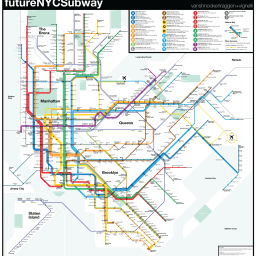
Subway diagram showing Flushing Trunk Line

Subway diagram showing Flushing Trunk Line


The futureNYCSubway

  1. Introduction
  2. IND Second System
  3. Post War Expansion
  4. The Second Ave Subway: History
  5. The Second Ave Subway: To The Bronx and the Nassau Line
  6. Brooklyn: Bushwick Trunk Line
  7. Manhattan: West Side and Hudson Crossings
  8. Queens: Flushing Trunk Line
  9. Staten Island: The Last Frontier
  10. TriboroRX and Atlantic Ave Super-Express
  11. Conclusion: the vanshnookenraggen plan

The futureNYCSubway: Manhattan’s West Side

Wednesday, May 19th, 2010

Introduction

Elevated Train, 9th Ave, 1940 by Andreas Feininger

Elevated Train, 9th Ave, 1940 by Andreas Feininger

Manhattan is the only borough of New York City where major subway expansion is actually taking place. The Second Ave Subway and the 7 Line extension are the first major subway expansion projects in almost 40 years. I’ve covered both in previous posts so I want to look further into what might be possible for expanded service in Manhattan. The areas along the west side of the island are still far away from subway service (elevated trains once rumbled up 9th Ave but were replaced in the 1930s by the 8th Ave Subway). The 7 Line extension, as it is currently being built, will not include a station at 10th Ave/41st St which will mean that trains will bypass a large residential section of town, Hells Kitchen and Clinton, in order to serve a neighborhood which is not even built yet, the Far West Side and Hudson Yards.

While over on the west side let’s look across the Hudson River and realize that there are many commuters who pour into New York from New Jersey every day through the Lincoln and Holland Tunnels and over the George Washington Bridge, the most heavily trafficked bridge in the world. There are also rail connection between New York and New Jersey via the PATH system and New Jersey Transit into Penn Station. Construction of a new 2 track tube under the river from New Jersey to Penn Station has recently begun which will double capacity along the Northeast Corridor (check out the ARC Tunnel). The PATH system went through an identity change in the 1970s when the Port Authority of New York and New Jersey took over the defunct Hudson & Manhattan Railroad which was built to shuttle passengers from various train terminals in Hoboken and Jersey City into downtown and midtown Manhattan. As service grows between the two states and as capacity along the automobile lanes is stretched to capacity, new rail connections seem inevitable.

Another inevitability is that Manhattan will need a new crosstown subway line soon. Planners have seen this as an issue for over 70 years as crosstown subways have been proposed from 57th St to 23rd St. Any new subway lines into Queens will have to enter Manhattan at some point and even with a completed Second Ave Subway there will be little extra capacity on existing East River tunnels. A new crosstown subway in midtown Manhattan would be ideal for adding the additional capacity needed and could be extended out into Queens.

Flushing Line 7 Train Extensions

7 Line extensions into the Far West Side of Manhattan.

7 Line extensions into the Far West Side of Manhattan.

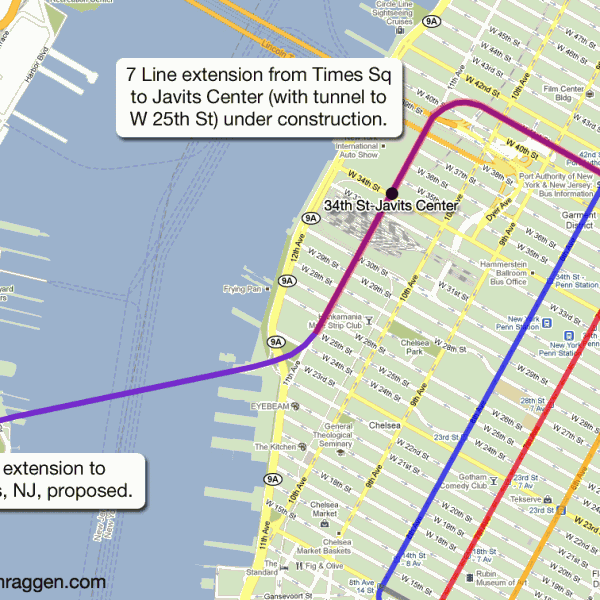
Currently under construction from 8th Ave/41st St to 11th Ave/34th St with layup tracks extending south to 11th Ave/25th St, I covered the history of the 7 Line extension in a previous post. Now I want to look at some past proposals for extension and some future possibilities.

  • High Line and West Side Highway

    Before the High Line was a park it was just another abandoned railroad line though a major city which most people didn’t even know about (you can see my pictures from before the park was built on my“A Walk on the High Line” post). In the 1980s and 90s when the West Side Highway was being torn down and replaced by the Hudson River Park and a landscaped boulevard, many transit advocates called for using this opportunity to build a new transit line along the west side to the World Trade Center. A transit option had been proposed as an alternative to the plans for the Westway, a massive highway tunnel system along the Hudson River to replace the decaying West Side Highway. When the Westway was killed in 1985 it was hoped that the new replacement would have space from transit of some kind, be it a subway, elevated rail, or bus lanes.

    The proposal to extend the 7 Line south along the west side would have brought the 7 Line west from Times Sq down to the Hudson Yards where it would have connected to the High Line at the point where the High Line tracks enter the ground along 34th St at 11th Ave. From here the 7 Line would have looped around the train yards and made its way through the middle of the block along the High Line. Since the High Line was built only for freight trains it never had stations (though each building through which it ran did have loading platforms for freight). New stations would have meant that many warehouses and residential buildings would have needed to be demolished. The High Line had originally run south to West Houston St where it terminated in a large meat packing facility. The portion of the High Line from Gansevoort St to West Houston St was demolished in the 1990s for new housing development. Had this section not been removed then it could have been extended along an elevated structure from West Houston south along the West Side Highway to a new terminal at the World Trade Center.

    History has written a different story. Though the West Side Highway was replaced by a landscaped boulevard and park system, no space for transit was made available. The High Line was in danger of being demolished entirely but was saved by creative community activists and a new mayor.

    Please note: I am not in favor of replacing the High Line Park with active rail transit. This was merely an historical proposal.

  • 23rd St Crosstown
    7 Line extension into Hoboken and Jersey City.

    7 Line extension into Hoboken and Jersey City.

    The current extension of the 7 Line will end at West 25th St at 11th Ave. Since 11th Ave starts/ends at West 22nd St there are only two options for where the line could be extended from here.

    The first option would be to turn the line back east at 23rd St and create a new crosstown subway. Crossing the East River at 23rd St the line would be pointing directly to Greenpoint, Brooklyn. The 7 Line could possibly be extended southeast into North Brooklyn or could be sent northeasterly back into the southern tip of Long Island City to connect back with the 7 Line to Flushing thereby creating a large loop through midtown Manhattan.

  • Hoboken and Jersey City

    The second option for extending the 7 Line past 25th St would be to send it west under the Hudson River into Hoboken, New Jersey. There are jurisdictional and bureaucratic issues with building anything across the Hudson River since it is a state boundary. The Port Authority was set up to build and maintain all interstate crossings inside a 25 mile radius area from the Statue of Liberty. Knowing this it is easy to understand why the New York City Subway has never crossed the Hudson River, but this does not mean the need does still not exist.

    The subway extension would leave Manhattan at 23rd St and head straight across the river to Hoboken at 12th St. The subway would curve south at Main St and head down to the Hoboken Terminal. Here there would be a transfer point for the PATH, Hudson-Bergen Light Rail, and New Jersey Transit. After Hoboken Terminal the subway would run parallel to the PATH down to Pavonia/Newport station, then down to 6th St where it would turn west. Jersey City was once covered in train tracks as it was the eastern most place trains could travel before they hit the mighty Hudson River. Jersey City was the home of many terminal buildings which allowed people and freight to transfer to barges headed to Manhattan. Because of this there are more than a few ruins left over from the railroad days. Like the High Line, Jersey City has a large abandoned railroad embankment running through the old residential neighborhood between 6th and 5th St. The 7 Line subway would ascend to the surface along 6th St here and run elevated along the embankment. The right-of-way leads directly to Journal Sq which is where the 7 Line extension would terminate, along side the PATH station.

  • Union City and the Upper West Side
    7 Line extension into Clinton, Union City, and the Upper West Side.

    7 Line extension into Clinton, Union City, and the Upper West Side.

    Back in Manhattan, instead of continuing the existing 7 Line south, an alternative would be to turn the 7 Line north into the Clinton/Hells Kitchen neighborhood along 10th Ave. On 10th Ave the 7 Line would run north to 72nd St where it would merge with the existing 7th Ave Subway at Broadway. From here north the 7 train would run along side the 1 train as a local service up to the Bronx. 10th Ave is interesting in this case since just west of 10th Ave, running through the block, is the depressed Amtrak right-of-way built at the same time as the High Line. This below grade rail line runs up the west side of Manhattan under Riverside Park and by Inwood before skirting the coast of the Hudson River up to Albany. This would allow for the 7 Line to act as a super-express subway for the west side of Manhattan up to Inwood. An actual current proposal for a similar transit expansion would have MetroNorth trains use this right-of-way with stations at 66th St, 125th St, and Dyckman St. MetroNorth trains would require no new tracks like a subway would so this is a much preferable and economical option.

    Alternatively the 7 Line could jump the Hudson River at 55th St and head into Union City, New Jersey. There is currently a train tunnel through the high cliffs on top of which Union City is built. The tunnel is currently being used for the Hudson-Bergen Light Rail. If these tracks were converted to subway service the 7 Line would have a ready to use tunnel into New Jersey. At the portal to the tunnel there could be built a large park and ride station which would attract commuters who might normally drive into Manhattan.

10th Ave and Crosstown Subways

10th Ave Subway and Crosstown alternatives.

10th Ave Subway and Crosstown alternatives.

As I stated above planners have seen the need for new crosstown subways for decades. In the 1960s an underground people-mover system was envisioned that would connect Grand Central Terminal with Rockefeller Center. Because the Midtown Central Business District (CBD) is so important to the economy of the region it is crucial that it is served well by transit. Since there is no more room for cars in this dense area the best option at the moment is mass transit. Currently there are crosstown subway lines at 59th St (N/Q/R trains), 53rd St (E), and 42nd St (7/Shuttle).

A new, 2 track, crosstown subway would serve an additional purpose, that of new capacity. Even if the 2nd Ave Subway is fully built out there will new capacity on existing lines in Manhattan but no new capacity in Queens. In my next post I will talk more about new subways in Queens but for these to be possible they need a place to go. A new crosstown subway in midtown Manhattan would be the perfect connection for a new subway to Queens. The 63rd St tunnel was built for this very reason but due to lack of funding no new capacity was constructed in Queens and the current 63rd St tunnel is operating under capacity because of this (read more about the history of the 63rd St tunnel here.)

The two best options for a new crosstown subway would be at 57th St or at 50th St. The 57th St alignment would connect with Columbus Circle, major express subway stations, and the hotel areas above midtown but the 50th St alignment would directly serve the CBD and still connect with major subway lines. A benefit to the 50th St alignment would be that an underground pedestrian mall could be constructed and connected into the existing concourse at Rockefeller Center. An underground concourse connecting Times Sq, the Midtown CBD, and Grand Central Terminal would reduce pedestrian traffic on the streets and allow for substantial retail which could help pay for the subway.

A cheaper alignment may be along 53rd St where the existing IND subway runs. The problem with this alternative is while the tunnel segment from 8th Ave to 6th Ave is 4 tracks, the tunnel from 6th Ave to the East River is only 2 tracks. Queens bound trains would have to be cut back to allow for an additional train, though an additional crosstown train at 53rd St would have the benefit of being able to directly connect to the 8th Ave Subway and add additional express service along the west side of Manhattan to downtown.

Crosstown subways from midtown Manhattan entering Long Island City.

Crosstown subways from midtown Manhattan entering Long Island City.

Where ever the crosstown subway is built it will have end up somewhere. Like the existing 14th St-Canarsie Line it could terminate at 8th Ave but because there is a large residential neighborhood just west of 8th Ave (Hells Kitchen/Clinton) it would make more sense to extend the subway over to 10th Ave and run it south to 14th St to connect with the 14th St-Canarsie Line. This would mean trains could enter from Brooklyn and unload passengers heading south, then swing north to serve the proposed Hudson Yards development and the Hells Kitchen neighborhood, then turn back east into midtown and on into Queens. Due to the commuting habits at rush hour it is foreseeable that there would be three different trains running on this subway: an all local train running from Brooklyn to Queens via 10th Ave, a Brooklyn only train at 14th St which would terminate at 10th Ave, and a Queens only train at 50th St (or another alignment) which would also terminate at 10th Ave. Off peak hours could run one or two all local trains from Brooklyn to Queens.

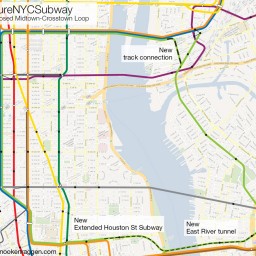
On the Queens side of the East River the new 10th Ave-Crosstown subway would need a place to enter Long Island City, a growing mixed use neighborhood. This fact has more to do with affecting the location of the new subway in Manhattan than anything else. Because existing subways in Long Island City are at capacity a new 4 track subway would need to be built. Currently the IND Crosstown G Line is cut back to Court Sq instead of connecting to the Queens Blvd Line and running to Forest Hills. Because of the ridership demand for midtown Manhattan service G train riders must transfer to the E/M trains to get to Queens Plaza. A new tunnel under the East River servicing a 10th Ave-Crosstown train would allow for the G train to finally get a proper terminal.

Depending on the alignment, a new 2 track tunnel under the East River would enter Long Island City and head towards Queens Plaza. A more southern alignment, like the one at 50th St, would meet up with the IND Crosstown G Line before Court Sq, thereby allowing a new tunnel and station to be built which would combine the two subways into a 4 track trunk line built parallel to the Queens Blvd Line to Queens Plaza. The new subway would be built inside the Sunnyside Rail Yards so no buildings would need to be demolished for this expansion to take place. A new 4 track terminal station would be built adjacent to the existing Queens Plaza station for transfers.

Morningside Ave Line

Proposals for a super-express subway to Morningside Heights.

Proposals for a super-express subway to Morningside Heights.

One of the more peculiar proposed subway lines from the original IND Second System was for a super-express subway under the west side of Central Park to Morningside Heights that would terminate at 145th St. The subway would have only had stations from 110th St to 145th St and would have connected with the BMT Broadway Line at 57th St. Early BMT subway maps actually show a small stud aimed this way at 57th St. While a new subway line through the Upper West Side was very much needed around this time, the peculiar thing is that this subway was still being proposed well after the 8th Ave Line opened, serving this same are.

My theory, and I have nothing to base this on, was that a Morningside Ave super-express subway was planned to compliment a pair of super-express tracks which were planned for the 2nd Ave Subway. Originally the 2nd Ave Subway was planned with 6 tracks through the Upper East Side, 2 local, 2 express, and 2 super-express with no stops until the line reached the Bronx. The subways through the Upper West Side were older, the original NYC Subway ran up Broadway, had two express stations at 72nd and 96th Sts, and only a third track for rush hour express trains after 103rd St. The areas around Morningside Heights, meanwhile, were rapidly developing at this time because of the improved transportation the new subways were bringing; in a sense the subways were too popular too handle the growing demand. A super-express subway would have taken considerable stress/directly competed with the IRT (keep in mind that the subways were still operated by three different companies at this time).

Today the shortcomings of the early subway designs are as evident as ever (for instance there is no express station at 125th St at Broadway). Already I’ve suggested three options for a super-express subway through the Upper West Side: a 7 Line extension along the Amtrak Hudson River tracks, a MetroNorth alternative along the same way, and a subway up Amsterdam Ave which would be an extension of the 14th St-Canarsie Line up 10th Ave.

Let’s add the original proposal into the mix, a branch off the BMT Broadway Line along Central Park. This would be the least disruptive option of them all since it would only require digging through the park. At the north end of the park the subway could swing west, like originally proposed, and run under Morningside Ave and Convent Ave to 145th St. Here the subway could terminate or merge with the IND 8th Ave Line and add super-express service directly to the IND Grand Concourse (B/D) Line in the Bronx. Alternatively, the subway could run under Lenox Ave in Harlem to 148th St (the IRT 7th Ave 3 train terminal) or connect to the IND Grand Concourse Line at Yankee Stadium.

George Washington Bridge Subway

George Washington Bridge with subway connection.

George Washington Bridge with subway connection.

The George Washington Bridge (GWB) is notable for many reasons, but one that is almost never mentioned is that it was the first major bridge built in New York City which was not built with a mass transit connection. The Brooklyn (1883), Williamsburg (1903), Queensboro/59th St (1909), and Manhattan (1909) bridges all were built with some form of mass transit but the GWB (1931), completed almost 30 years after the Manhattan Bridge, did not. What has been noted many times was that it was overbuilt (the original design called for a skin of brick and granite) and space was left over for a second deck which would have allowed for mass transit. A second deck was added in the 1960s but no mass transit option was built, not even a bus lane which could have served the busy bus terminal on the Manhattan side of the bridge. Because the bridge spans the Hudson River the bridge is owned and operated by the Port Authority of New York and New Jersey there are legal, jurisdictional, and bureaucratic issues that need to be dealt with if mass transit is to be a reality on the GWB.

There are two ways that mass transit could operate on the GWB, both of which would require the removal of a travel lane in each direction. This may seem counter productive since the GWB is the most heavily trafficed bridge in the world but mass transit would only cut down on the amount of space for cars; many more people could cross the bridge if mass transit was added.

  • Bus Lanes

    A bus-only lane along the top deck would better serve the bus terminal on the Manhattan side. The GWB Bus Terminal is a strategic part of the region’s transportation network which diverts traffic away from the main Port Authority Bus Terminal at 42nd St. A bus-only lane would also allow charter buses, which would normally cross along at one of the tunnels further south, a quicker way into Manhattan.

  • Subway

    An extension of the IND 8th Ave Line from 168th St (the current terminus for 8th Ave local trains) across the lower deck of the bridge to a new transportation facility/relocated bus terminal in Fort Lee, NJ. There exists, underground, a train yard under Broadway at 174th St to serve 8th Ave trains. The tracks connecting the yard to the 8th Ave Subway could be extended up Broadway a few blocks and curved west to run along the lower deck of the bridge (see map). On the New Jersey side a large new bus terminal and park-and-ride facility would be built where commuters would transfer to express trains to Manhattan. The facility would be built above the existing highway when space is freed up from the removal of the tool booth plazas (which would be replaced by automated license plate readers currently being installed on other bridges). The air-rights on the New Jersey side and the air-rights from the removal of the existing GWB Bus Terminal in Manhattan would be a way to finance the subway.

Conclusion

The unfortunate fact about all the subway expansion going on in New York City right now is that when it is all finished the Far West Side, Clinton, and Hells Kitchen neighborhoods won’t be that much better off. New subway connections which would extend existing lines through these neighborhoods are needed when the planned developments (and current developments along W42nd St) start to bring thousands more people into this area. This being the case it only makes sense to look at these transportation needs in a broader context. Subways in Manhattan are already close to (and in some places surpassing) their designed capacity. If other boroughs of the city are to grow (an additional 1 million people are expected to move into the city within the next 20 years) they will need a way to get around. New subways are the only desirable answer.

I’ve talked about new crosstown connections into Queens and in my next post I will discuss just where those new subways will lead to: the Flushing Trunk Line.

Subway Diagram

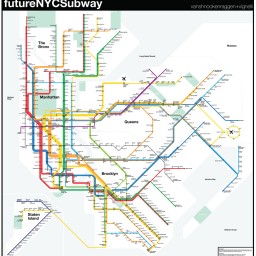
Subway diagram showing 10th Ave Subway, 7 Line to Hoboken, Bushwick Trunk Line, and Second Ave Subway systems.

Subway diagram showing 10th Ave Subway, 7 Line to Hoboken, Bushwick Trunk Line, and Second Ave Subway systems.


The futureNYCSubway

  1. Introduction
  2. IND Second System
  3. Post War Expansion
  4. The Second Ave Subway: History
  5. The Second Ave Subway: To The Bronx and the Nassau Line
  6. Brooklyn: Bushwick Trunk Line
  7. Manhattan: West Side and Hudson Crossings
  8. Queens: Flushing Trunk Line
  9. Staten Island: The Last Frontier
  10. TriboroRX and Atlantic Ave Super-Express
  11. Conclusion: the vanshnookenraggen plan

The futureNYCSubway: Bushwick Trunk Line

Monday, May 3rd, 2010

Introduction

1924 BMT dual contracts map

1924 BMT map showing existing elevated lines (in black) and proposed subways.

Because of how and when Brooklyn developed in the 19th Century it has today one of the most extensive subway and elevated rail networks in the entire nation, and it is only one borough of the city. So many lines criss-crossed Brooklyn back in the day that, unlike many other cities who’ve expanded service over the last century, Brooklyn has actually lost miles of tracks due to the dismantling of elevated lines through Bedford-Stuyvesant and Borough Park. Still, Brooklyn remains one of the most well served areas in the nation in terms of subway lines. However, there are still major sections of Brooklyn that developed after World War II and outside the range of subway service.

The city foresaw this development and planned to build subways to Flatbush, Flatlands, and Sheepshead Bay but was stopped by the Great Depression and changing priorities (e.g. the car). When the Independent subway released its grand expansion plan in 1929 it included a major trunk line though northern Brooklyn that branched out to reach the Rockaways and Sheepshead Bay. The lines connected to the 6th Ave and 8th Ave Subways had at one time up to 8 tracks servicing four different subways branching off into Brooklyn and Queens.

Much has changed in northern Brooklyn since those days. Back then there were three major elevated lines in northern Brooklyn; the Jamaica Line elevated which still runs today (J/Z trains), the Myrtle Ave elevated which once ran all the way from dowtown Brooklyn to Metropolitan Ave but was cut back to Broadway in the 1950s (M train), and the long gone Lexington Ave elevated line which ran through Bedford-Stuyvesant along Lexington Ave and was also torn down. Many of the neighborhoods of northern Brooklyn suffered severe population drains after World War II. Much of the industry left and by the 1980s the area became one of the poorest in the nation.

It is amazing then how far we have come within a generation. Due to the low cost of real estate and the availability of large loft warehouses, Williamsbug has gone from a no-mans land to being the newest, hippest neighborhood in the city. During the 1990s due to waves of new immigration from South America, Bushwick began to stabelize. As gentrification moved east from Williamsburg areas of Bushwick and Bedford-Stuyvesant began to gentrify. Today the area’s population has grown dramatically fom 10 years ago and ridership levels on every subway station in Williamsburg, Bushwick, and northern Bedford-Stuyvesant have risen. This now presents the problem: how will the century old transit infrastructure handle this new growth?

Now I am bringing this proposal back, a new trunk line serving northern Brooklyn with branches out to Queens and southeastern Brooklyn that will replace the antiquated Broadway and Myrtle Ave elevated tracks and allow for better local service and faster commutes from the far reaches of the city. This new subway is called the Bushwick Trunk Line.

6th Ave and 8th Ave Subway Connections

1929 IND Proposal for South 4th St subway.

1929 IND Proposal for South 4th St subway.

The original proposal from the 1920s was called the South Fourth St Subway for the street under which it ran. It began in two places in Manhattan, both vestiges of the IND Second System. On the 6th Ave Line at 2nd Ave station there are 2 platforms and 4 tracks. Only the outer tracks have ever been in service with the inner tracks used, until 2010, as a terminal for the V train. The inner tracks were originally built to service trains coming from Williamsburg via a tunnel under the East River. This is the first part of the Bushwick Trunk Line proposal. The second is over on the 8th Ave Line. After Canal St station on the 8th Ave Line the express and local tracks diverge into two separate tunnels. Today the A and C trains run on to Brooklyn through on one set of tracks while the E uses the other set to terminate at World Trade Center. It is these tracks, the World Trade Center tracks, that were originally supposed to head east under Worth St. The so-called Worth St Subway made a short jog along Worth St to East Broadway and down to Grand St where it dove under the East River towards Williamsburg. Both of these tunnels, at some point in Williamsburg, would have come together to form a 4 track subway under South 4th St. There were various proposals for where this would happen and various schemes for how many trains would run. The line would have been able to handle 2 express and 2 local with branches out to the Rockaways and Sheepshead Bay.

Because my proposals encompass as vaster area then along South 4th St I’ve taken the liberty to rename the proposal the “Bushwick Trunk Line”. A trunk line is a main line of a railroad that is created by combining many different passageways that branch off at some point. For instance the Lexington Ave Subway is a trunk line because it combines the 4/5/6 trains in a subway under Lexington Ave. The Bushwick Trunk Line would combine trains from central Queens, Jamaica, Flatlands, Sheepshead Bay, and Bushwick into a single massive subway and redistribute them into Manhattan.

Bushwick Trunk Line connections into Manhattan.

Bushwick Trunk Line connections into Manhattan with alternatives.

To update the original plan we have a few different options. On the 6th Ave Subway a new tunnel should still continue east along Houston St across the East River to South 4th St in Williamsburg. A station will be placed between Aves B and C to give subway access to one of the only areas of Manhattan still without close subway access. A proposal from the 1930s also brought in a connection with the Second Ave Subway which would branch off before the 2nd Ave station at Houston St and run parallel to the 6th Ave extension under Stanton St. The two subways would combine somewhere under the East River.

The 8th Ave Subway connection would be shifted south from the original proposal under Worth St to Chambers St where a new transfer facility would be constructed connecting the Lexington Ave Subwayand the Jamaica/Centre St Subway. From here the new subway would continue along the original route under East Broadway to Grand St and under the East River to connect with the 6th Ave extension to form the bulk of the Bushwick Trunk Line. Alternative alignments would have the subway running under Clinton St and merging with the 6th Ave extension before the East River or running the 8th Ave extension along Broadway in Williamsburg and connecting with the 6th Ave extension further east.

While in Williamsburg another subway connects to the Trunk Line; the Jamaica Line which today runs on an elevated track. A new portal would be constructed at the Brooklyn approach of the Williamsburg Bridge to connect the tracks on the bridge to the new subway. The elevated tracks would be torn down.

For those keeping track of the tracks, there would be two, 2 track tunnels under the East River meeting at a single 4 track station at Berry St and South 4th St. Continuing east the Jamaica Line would connect adding 2 additional tracks making 2 local tracks and 4 express tracks. These 6 tracks would run to Union Ave where at the Broadway Station on the IND Crosstown G Line is the shell of a 6 track station which was built in anticipation of the South 4th St Subway.

If you think about this in transportation planning terms then the Crosstown Line suddenly becomes a lot more useful. There is very little traffic between downtown Brooklyn and Long Island City but this was not supposed to be the case. The South 4th St subway was meant to meet with the Crosstown Line between downtown Brooklyn and Long Island City which would have added much more traffic to the line, distributing commuters more efficiently and taking pressure off transfer points in Manhattan.

Bushwick Trunk Line

Bushwick Trunk Line track map.

Bushwick Trunk Line track map.

East of Union Ave the Trunk Line would run north of and parallel to Broadway which would require cutting a new street from South 4th/Union Ave to Beaver St/Flushing Ave. A routing along Broadway would necessitate the demolition of the elevated train before new service would be built to replace it. The city has a very poor track record of replacing elevated trains with subway service which is why the more expensive option of cutting a new street would be the better one.

The purpose of the Bushwick Trunk Line is to allow for modern subways to service outlying areas of the city, bring them together to sort passengers, and transport them out into different areas of Manhattan (and downtown Brooklyn). The different subways coming together in the Trunk Line are the Myrtle Ave Subway/Union Turnpike Subway (with a branch of the Crosstown Line), the Utica Ave Subway (with connections to the Canarsie Line), and the replacement subway for the demolished Jamaica Line elevated tracks. The Trunk Line would have 2 local tracks and 4 express tracks which would be below the local tracks.

6 tracks running from South 4th St under the new street would merge again with a new branch of the 14th St-Canarsie Line. This branch would break off the Canarsie Line after Montrose St and continue south under Bushwick Ave. This merger would occur right before a massive new transfer station at Myrtle St/Bushwick Ave. This station would be very similar to the West 4th St station with two sets of 4 track platforms separated by a mezzanine. 8 tracks would enter the station, 12 tracks would leave the station; 4 tracks for each branch line. To wrap your head around what I’m proposing here I’ve created a track map. A track map shows each track as a thin line. Here I have color coded each set of tracks to show which trains would run where. Platforms are the solid rectangles. Dashed lines indicate when a track runs below another track (3rd dimension).

After Myrtle Ave the different subways would branch off but a 4 track subway would continue east under Bushwick Ave to replace the Jamaica Line elevated. The new subway would go as far as the train yards at Broadway Junction where the tracks would rise to the surface and continue along the existing elevated structure. In a later post I will address what can be done about the existing elevated line.

Myrtle Ave Subway and Crosstown Subway Connection

Bushwick Trunk Line with alternative routings.

Bushwick Trunk Line with alternative routings.

The Mrytle Ave Subway would be the first branch off the Trunk Line and would be a replacement for the elevated train currently along Myrtle Ave through Bushwick and Ridgewood. The Myrtle Ave Subway would split off the Bushwick Trunk Line after the Myrtle Ave station and travel northeast under Myrtle Ave to Fresh Pond Rd where it would rise to the surface, run at grade, to travel along side the Long Island Railroad Montauk Branch tracks. At this point there would also be a separate track system to connect the new subway to the existing Fresh Pond train yards. The subway would be 4 tracks serving 8th Ave trains.

A number of alternatives are available. The first would utilize an old freight rail line which terminates at Bushwick Place and Montrose Ave. This line once ran passenger trains from Williamsburg to Coney Island and Long Island but cut this service in the 1920s. The first alternative would have a subway branch off the Bushwick Trunk Line right after the Union Ave station running under Montrose Ave and rising to the surface to run at grade somewhere after Varick Ave along this stretch of track. The line would follow the freight tracks until Flushing Ave where they would run along side the LIRR Montauk Branch tracks, continuing east. A second alignment in this would run the subway under Flushing Ave for a while before connecting with the LIRR Montauk Branch. This second alignment would be more costly than the freight track alignment but would have the benefit of closer to residential areas.

Vestigial tracks as Bedford-Nostrand.

Vestigial tracks as Bedford-Nostrand.

A downside to the Myrtle Ave Subway alignment is that it runs south of the current elevated subway through Ridgewood. An alternative that would address this would run the subway up Gates Ave to the point where it meets the LIRR Montauk Branch tracks. This alignment would serve more people as it runs through the heart of the neighborhood and would also run close by the Fresh Pond train yards but a major downside would be very disruptive construction along residential streets.

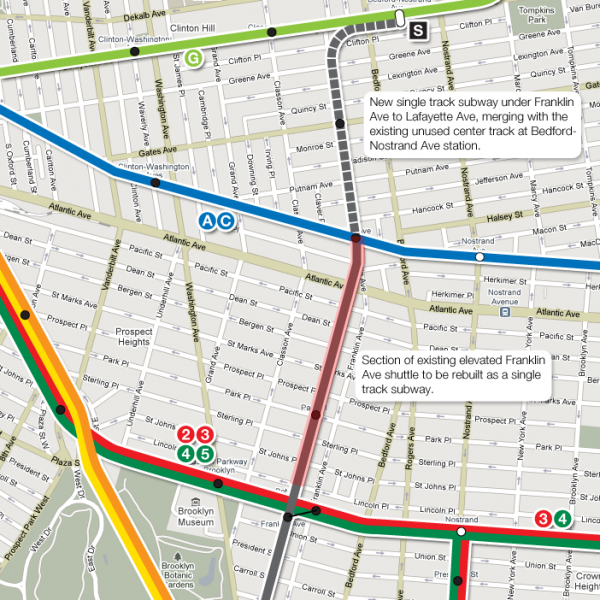
Though the Myrtle Ave Subway would mainly branch off of the Bushwick Trunk Line I also call for a new subway which would branch off the IND Crosstown Line after the Bedford-Nostrand Aves station. A commuter using said station will note that there are in fact 3 tracks with 2 island platform, strange since the Crosstown Line has only local service and runs with 2 tracks for the rest of its length (see pictures at NYCSubway.org). There are two thoughts to why this extra track exists, the first being that it was designed to be a terminal station for service changes, and second that it was designed to be a junction station where two subway lines would combine. The middle track at Bedford-Nostrand continues east while the outside tracks curve to the north. The third track then splits into 2 tracks but dead ends (which could be used for layups of trains of extending service east). This dead end is where we start, continuing the subway along Lafayette Ave to Broadway where it would curve northeast under Kossuth Pl and Stanhope St, connecting with the Myrtle Ave Subway before Knickerbocker Ave.

This additional tunnel would allow service from central Queens three options of service: an express into Manhattan, a local into Manhattan (both of which would allow for easy transfers to uptown or downtown trains) and a local to downtown Brooklyn. The new Crosstown Line Connection would also finally repair the connection between northern Brooklyn and downtown Brooklyn which was severed when the Myrtle Ave elevated was taken down in the 1960s.

Union Turnpike Subway

Union Turnpike Subway through Forest Hills.

Union Turnpike Subway through Forest Hills.

The Myrtle Ave Subway would continue east into Queens through Glendale along the LIRR Montauk Branch tracks to Forest Hills. After Woodhaven Blvd the subway would run under Union Turnpike. The Union Turnpike Subway would continue east under Union Turnpike to the Nassau County border. This 4 track subway line with three trains would be the first to open up a large section of central Queens to new subway service into downtown Manhattan and Brooklyn. The subway would intersect the Queens Blvd Line so commuters would be able to switch to express trains to Long Island City and midtown Manhattan. At Queens Blvd/Union Turnpike there would be a connection between the tracks of the two subway lines which would enable trains from the Union Turnpike Subway to access the existing train yards just north of Union Turnpike, the Jamaica Yards.

An alternative alignment would run the subway under Metropolitan Ave through Middle Village. This alignment would run closer to residential areas but would also be much more expensive than a subway running at grade along the LIRR tracks. The Metropolitan Ave alignment would, however, allow for an alternative western alignment of the new subway which would swing up and around Forest Hills to merge with the Queens Blvd Subway (as opposed to running south of Forest Hills.) This alternative alignment would be a good option if funding comes up short which would prevent the subway from just ending in the middle of nowhere (Please note that I am not saying that Forest Hills is the middle of nowhere.)

Union Turnpike Subway through Utopia and Glen Oaks.

Union Turnpike Subway through Utopia and Glen Oaks.

(Side Note: In these and future posts I include in each proposal from all previous expansion plans so that they build on one another. As such in each of these maps here you can see my plans for Second Ave Subway extensions into Queens. For explanations of these extensions see the Second Ave Subway post.)

After Forest Hills the Union Turnpike Subway would run one of two ways: the first would be straight down Union Turnpike to the Nassau County border, and the second would be a more northernly route under Jewel Ave. This second alignment would require a large “S” curve in the routing of the subway after Forest Hills which would run the subway at grade along the Van Wyck Expressway up to Jewel Ave where it would turn east again. With either alignment the 4 track subway would run to 188th St where the local trains would terminate and the express trains would take over. The subway past 188th St could either run in a 2 track or a 3 track tunnel to allow peak period express trips (much like the IND Grand Concourse B/D Subway does today). An alternative to running the subway out to Glen Oaks would have the line jog south at the Clearview Expressway to connect with an extended Hillside Ave subway to Queens Village and Bellerose.

Utica Ave Subway

Utica Ave Subway through Flatlands and Sheepshead Bay.

Utica Ave Subway through Flatlands and Sheepshead Bay.

The Utica Ave Subway comes from the original IND Second System expansion plans from the 1920s and 30s. This area of Brooklyn was still largely undeveloped at that time and the subway would most likely have been built as an elevated structure to save money. After the neighborhoods of Flatlands, Sheepshead Bay, and Gerritsen developed after World War II it became too unpopular to build an elevated structure but too costly to justify a subway even though the demand was higher than ever. A subway under Utica Ave still remains in transit planners minds as ideas have been proposed for long term expansion during the last 50 years that involve a scaled back subway branching off the IRT Eastern Parkway 3/4 Line or the IRT Nostrand Ave 2/5 Line.

My updated proposal keeps true to the original with a slight difference. In the original proposal the Utica Ave Subway would branch off the Bushwick Trunk Line after Myrtle Ave and travel down Stuyvesant Ave to Fulton St. At the Utica Ave station on the Fulton St Subway there is a 4 track express shell station which was constructed in anticipation of the Utica Ave Subway. My proposal runs the subway a block east under Malcom X Blvd/Reid Ave to avoid demolition of a school building. From there the subway would run straight south down Utica Ave to Flatlands Ave. Here the subway could take a number of different routes. The first would be to keep running south to Flatbush Ave. Another would be to turn southwest under Flatlands Ave and run to Nostrand Ave where it would continue south along Nostrand Ave to Voorhies Ave. Both of these options were proposed during the 1920s and 30s plans.

Utica Ave Subway through Bedford-Stuyvesant and Crown Heights.

Utica Ave Subway through Bedford-Stuyvesant and Crown Heights.

On major difference between the original plans and my plans are that I call for a connection between the 14th St-Canarsie Line and the Utica Ave Subway at Myrtle Ave (see track map above). Historical proposals all called for a 4 track subway with express and local service. However these proposals existed before the Chrystie St Connection which allowed 6th Ave trains to run into south Brooklyn. The original proposal for the Utica Ave Subway had local and express 6th Ave bound trains which is today not possible since adding a fifth service to the 6th Ave Subway would congest the line too much. This is why I propose a connection between the Canarsie Line which would run 6th Ave trains express and 14th St trains local. All trains on the Utica Ave Subway would run to midtown since there would be no less than four different points along the line where commuters would be able to transfer to express trains to downtown Manhattan (making Utica Ave trains running to downtown Manhattan quite redundant).

Then there is the extension of the IRT subway. Alternatives proposed in the past have run an IND and IRT subway parallel to each other or a combined subway. In the map to the right I explore both options. My only issue with extending the IRT subway south is that the Nostrand Ave Subway is currently only a 2 track local subway and extending the line so far south without an express train would make travel times much longer and be much costlier than just building a 4 track Utica Ave Subway with express and local service. Adding an express track to the Nostrand Ave Subway would be far too disruptive to service which at that point would make a new 4 track subway under Utica Ave justifiable.

Conclusion

To sum up the Bushwick Trunk Line services: 6th Ave express (restored “V” service) and 14th St-Canarsie local (a new “O” service) trains would run along Utica Ave, 8th Ave express and local trains (“A” service and a new “H” service), added by a Crosstown local train (a new “K” service), would run out along Myrtle Ave/Union Turnpike Subways, and Jamaica Line express and local trains (existing “J” and “Z” service) would continue to run out to Broadway Junction but in a new subway. All elevated structures between the Williamsburg Bridge and Broadway Junction would be demolished.

There are three major reasons why a new trunk line subway is needed for northern Brooklyn. Firstly, the existing infrastructure is old and cannot handle the foreseeable population increases. Northern Brooklyn was one of the worst hit areas of urban decay during the latter half of the 20th Century but has begun to stabilize with an influx of new residents attracted by low land prices. Secondly, any addition service to areas of Brooklyn and Queens which are today out of reach by subways need fast express capacity to ferry commuters from so far out into the central city. Current subways are either at capacity or are in no shape to be extended further out. This speaks to the failure of the city to properly plan for post World War II residential development. Had the original IND Second System proposals for a trunk line subway through northern Brooklyn been even partially completed then major parts of the city would be better accessible today.

Thirdly, there no more room for the city to spread outwards. Even with this current recession, population trends locally and globally point to increased urbanization. Brooklyn and Queens were consolidated into Greater New York City in 1898 precisely because they had space. Today, while they lack horizontal space, the average height of a building in these boroughs is still only a few stories. Highways and roads can handle only so much. New mass transit routes are needed if the city is to grow and growth in suburban areas of Brooklyn and Queens is the next logical step. As hard as it is to imagine now the skyscrapers of midtown Manhattan were once small hamlets and farms. The suburban streets of central Queens may one day be home to large apartment houses. It is very probable that there will be resistance to such growth but there will come a time when it is inevitable and the infrastructure must be put in place lest the city choke on traffic.

These subway plans are only one part of this growth. I believe that the growth can be properly planned in conjunction with expanded infrastructure. If not what will happen city wide is what has happened to Williamsburg; the transportation infrastructure has not been able to keep up with the residential growth. There is much push back now towards more development due to the lack of capacity. If the South 4th St Subway had been built 60 years ago then this would not be an issue. The city is building an extension of the IRT 7 Line to the Far West Side of Manhattan in anticipation of development, what would happen if the city built subways to where there already is major development choking current infrastructure?

Subway Diagram

Subway diagram showing Bushwick Trunk Line and Second Ave Subway systems.

Subway diagram showing Bushwick Trunk Line and Second Ave Subway systems.


The futureNYCSubway

  1. Introduction
  2. IND Second System
  3. Post War Expansion
  4. The Second Ave Subway: History
  5. The Second Ave Subway: To The Bronx and the Nassau Line
  6. Brooklyn: Bushwick Trunk Line
  7. Manhattan: West Side and Hudson Crossings
  8. Queens: Flushing Trunk Line
  9. Staten Island: The Last Frontier
  10. TriboroRX and Atlantic Ave Super-Express
  11. Conclusion: the vanshnookenraggen plan

The futureNYCSubway: 2nd Ave Subway Future

Thursday, April 1st, 2010

The futureNYCSubway Introduction

The last four posts have all been about the history of subway expansion in New York City. The remaining posts will focus on the future of subway expansion as I envision it. Many of the expansion plans I have incorporated into this expansion, not just an expanded Second Ave subway but system wide, have been based on many historical plans for expansion, hence all the history. Some of my plans are new, especially plans for Queens which developed after World War II and around the car rather than mass transit. When I’ve show my final map to friends they found it hard to visualize the changes I’ve made which is why I am going to go through each expansion plan and describe what’s new, what some alternatives are, and how it fits into the system today and the system of my dreams.

The Second Ave Subway: Full Build

Second Ave subway phase map

Second Ave subway phase map

The map to the right is from the MTAs website showing the current phased plan for 2nd Ave subway construction. The red section is currently under construction containing stations at 72nd, 86th, and 96th streets. The blue section above that is Phase 2 running north to 125th St where provisions would be made for further extension under 125th St and north into the Bronx. Stations here are placed at 106th, 116th, and 125th streets (the dashed section of the map indicated sections of tunnel already constructed from the 1970s.) Phase 3 is the yellow section running south from 63rd St to Houston St. Stations are planned at 55th, 42nd, 34th, 23rd, 14th, and Houston streets. The final phase is the green section running from Houston St under south to Hanover Sq in the Financial District. Stations are planned at Grand (which is already there), Chatham Sq, Seaport (at about Fulton and Pearl Sts), and Hanover Sq. The current plan is a stripped down version of the 1968 plan which itself is a stripped down version of the original plan. As built the 2nd Ave subway will be only two tracks running from 125th St to Hanover Sq with only one local train, the T, from Hanover Sq to 63rd st and two local trains, the T and the Q, up to 125th St. Construction on Phase 1 has been pushed back to 2016. After that there are no solid plans for the other phases.

Manhattan Trunk Line

I advocate that the only way for the 2nd Ave subway to really put a dent into curbing congestion along the east side of Manhattan AND to allow for expanded service into the other boroughs that a second set of tracks be constructed for express service from 125th St to Houston St. Given that the majority of this route has not been constructed it would still be possible to build at a lower cost than building a second set of tracks below the tracks being constructed now. The MTA already shaved down the 72nd St station from 3 tracks to 2 (a third track would have aided in trains switching from the 2nd Ave subway into the 63rd St subway). At the very least they could design the new line to allow for future expansion to 4 tracks (as they did when building the 6th Ave line whose express tracks weren’t built for another 20 years after the local tracks.)

As it is designed now the 2nd Ave subway will only carry 2 local trains from 125th St to 63rd St. Below at 63rd St there will be a connection to the Queens Blvd line (F train) and though no plans have been released to indicate what kind of service will run here this means that potentially there will also be two local trains running from 63rd St to Hanover Sq. An express track would only be necessary when service is extended north into the Bronx but not allowing for an express track will only make that future expansion all the more expensive.

In addition to not having an express track, the stations along the line are spaced further apart than many of the other subways in Manhattan. For instance on the Lexington Ave line there are stations at 59th, 68th, 77th, and 86th streets while on the 2nd Ave line stations are further apart, at 55th, 72nd, and 86th streets. Further south there is no station at St Marks between 14th St and Houston St. St Marks is THE main street of the East Village and a major area of nightlife activity. Omitting a station here is a terrible idea. The reasons for spacing stations so far apart is due to the lack of express service; making local service faster (from fewer stations) is a cheaper alternative but one that ends up hurting the East Side. I advocate for adding two stations and relocating a third; move 55th St to 57th St and add an additional station at 50th or 49th St in Turtle Bay and add a station at St Marks.

Lower Manhattan and Downtown Brooklyn

2nd Ave subway alternatives in lower Manhattan.

2nd Ave subway alternatives in lower Manhattan.

  • Ave C Spur

    The first extension alternative is one proposed by the TransportPolitic which would serve one of the few areas of Manhattan that would still not have rapid transit even after the 2nd Ave subway is completed. On the east side of Manhattan there is a large bulge south of 23rd street; the Lower East Side, East Village, and Alphabet City (so named because of the Avenues A, B, C, and D). Because of this bulge east side residents have to walk the furthest of all Manhattanites to reach subways. The area is bordered on the north, south, and west by ample subway service but the heart of the area, home to some of the poorest residents in the borough, is still a very long walk away. This proposal creates a spur line that branches off the 2nd Ave trunk line at 14th St and then heads south along Ave B or Ave C. In the TransportPolitic plan there would be stops at Tompkins Sq and Delancey (under the Williamsburg Bridge) and connections to the L and F trains at 14th St and East Broadway, respectively. This plan is not without precedent as the former 2nd Ave elevated line, which ran up 2nd Ave until 1940, actually made a similar jog in its route when at 23rd St it would turn off 2nd Ave and move over to 1st Ave to better serve the very dense Lower East Side.

  • 8th Ave Subway Connection

    One of the original proposals for the 2nd Ave subway back in the 1920s was, when reaching downtown, to have the line loop back north via a connection with the 8th Ave subway. A second proposal from that time had a spur of the 8th Ave subway branch off at Worth St that would travel up East Broadway and into Williamsburg. As a hybrid of these two proposals, the Ave C alignment would run under East Broadway and continue along Park Row and Chambers St where it would connect with the 8th Ave subway. This connects express service from the Lower East Side to downtown and express service on the West Side, acting as a default cross town connection. This would better connect the Lower East Side to virtually every other part of Manhattan as well as lines into Brooklyn. The 8th Ave local (E) already terminates at World Trade Center and could easily be routed back north as a second 2nd Ave local service to 63rd St, creating in a way a starting at Queens Plaza, running along the West Side to downtown, then returning to Queens via the 2nd Ave subway.

  • Williamsburg Bridge Connection
    1951 plans for the Second Ave subway and connection to Brooklyn

    1951 plans for the Second Ave subway showing connections to the Williamsburg and Manhattan Bridges and the Centre St subway.

    Taking a proposal from the 1950s, this would effectively terminate the 2nd Ave subway at Houston St (where Phase 3 is planned to end anyway) and connect it directly to existing subway tracks to Williamsburg via the Chystie St Cut. In this proposal service would replace the M train to Metropolitan Ave-Middle Village but service could also be extended to Broadway Junction, Canarsie, or Jamaica.

  • Manhattan Bridge Connection

    Ending the 2nd Ave subway at Houston St would also allow connection to the Manhattan Bridge via Grand St. When Grand St station was constructed it was designed to allow future 2nd Ave service to be built around it (by this I mean the walls on each platform would be demolished and an outside set of tracks from the 2nd Ave subway would surround the station creating two island platforms.) As service along 2nd Ave in the Upper East Side will be provided by the Q train, which runs over the Manhattan Bridge, it is possible to continue the 2nd Ave service along the Brighton Beach line (todays B train) or even along the 4th Ave subway in Brooklyn out to Bay Ridge, Bensonhurst, or Coney Island. These two connections would be a good alternative if construction costs rise so much that Phase 4 of the 2nd Ave subway is postponed.

  • Broad St Connection

    One proposal looked at for Phase 4 of the 2nd Ave subway was to connect it directly to the Centre/Broad St subways (J/Z). The proposal looked at had the connection made at Delancey St which may necessitate the destruction of the Bowery station (or the destruction of the half of the station which is currently unused). The reason that such a connection was weighed is that there is a second set of tracks along this section of subway which have been unused since the completion of the Chystie St Cut. These tracks once connected Chambers St with the Manhattan Bridge. This proposal slightly alters this route by making the connection further south, after Grand St, to the unused tracks that run from the Bowery under Canal St to Centre St (click here to see a tack map of the area showing the unused tracks I am referring to). Service to Williamsburg would terminate at Chambers St and the 2nd Ave line would continue through Broad St to Whitehall-South Ferry and on into Brooklyn where it could easily pick up service out to Bay Ridge, Bensonhurst, Coney Island, or Brighton Beach.

  • New East River Tunnel

    Phase 4 extends the 2nd Ave subway from Houston St to Hanover Sq. The final alternative would be a new tunnel under the East River (2 tracks) which would connect the 2nd Ave subway from Hanover Sq to the Court St station (now used as the NY Transit Museum but would at this time be converted to revenue service.) Since Court St station was originally a real subway station it connects to Hoyt-Schermerhorn station along the set of tracks into the outer most platforms at Hoyt-Schermerhorn. If you go to Hoyt-Schermerhorn station you will notice a platform on each side that is closed and covered in dirt, these were for trains heading to Court St and were shut after Court St was closed (click here for a tack map showing the unused tracks and platforms). This would allow 2nd Ave service to run straight through central Brooklyn and into southern Queens, also connecting Midtown East and Downtown to JFK Airport. As proposed, the 2nd Ave subway does not make a connection to the 8th Ave line so this would allow wuick transfers to be made for commuters from central Brooklyn to the east side of Manhattan.

Harlem and the Bronx

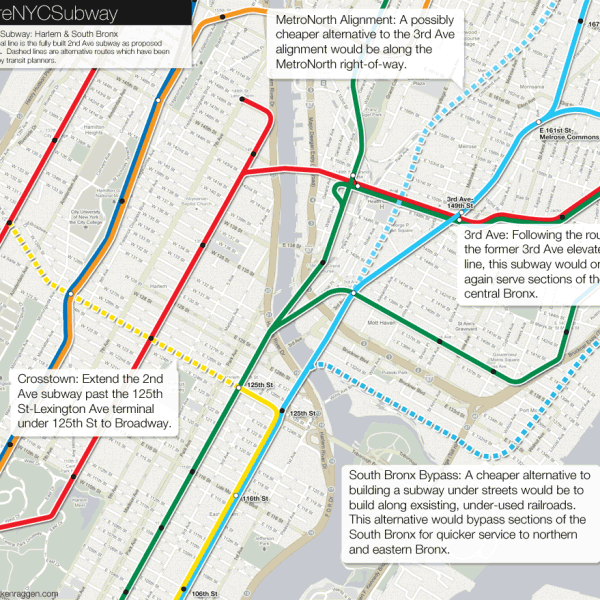
2nd Ave subway alternatives in Harlem and the South Bronx.

2nd Ave subway alternatives in Harlem and the South Bronx.

  • 125th St Crosstown Line

    The current Phase 2 of the 2nd Ave subway is planned to terminate at 125th St-Lexington Ave with connections to the 4/5/6 trains and MetroNorth. There has been speculation that this would inevitably lead to an extension of the line from Lexington Ave to Broadway under 125th St, thus creating a crosstown subway line. 125th is the main street of Harlem and as anyone who has ever tried to take a bus crosstown on 125th street can attest to it is very congested. Commuters on the west side would no longer have to take crosstown buses or travel down to 42nd St to travel to the east side. A crosstown line would also siphon off riders from the other major trunk subways (Broadway, 8th Ave, Lenox Ave, and Lexington Ave) from the Bronx over to the east side thereby reducing congestion along all of upper Manhattan. The TransportPolitic also has a good write up about advantages of a 125th St-Crosstown line and why it should have priority over a fully built 2nd Ave subway.

The Bronx

  • 3rd Ave/MetroNorth Alignment

    Manhattan was once lined north to south with elevated trains and the east side had two, the 3rd Ave el and the 2nd Ave el. At 129th street in Harlem the two lines merged and headed into the Bronx along a route between Alexander Ave and Willis Ave north to 149th St where they split, one branch heading east to West Farms (todays 2/5 trains) and another heading north to Fordham and Norwood where at Gun Hill Road the lines once again merged to finally terminate at 242st St in Wakefield. The line that headed north ran along 3rd Ave in the central Bronx, home to thriving Italian first and second generation families escaping the tenement districts along the east side of Manhattan. The 3rd Ave el in Manhattan was torn down in 1955 but the section from 149th St to Gun Hill Rd remained. From the 1960s on this section of the Bronx saw the worst of white flight and urban decay. Many of the famous sights from that time of graffiti covered elevated trains rumbling through an urban wasteland were of the 3rd Ave el. When the MTA had the subway lines renamed in 1960s the 3rd Ave el was known as the 8 train (as it was part of the IRT system). The line was eventually torn down in 1973. Since then this major section of the Bronx has had no direct subway service into Manhattan.

    The 3rd Ave alignment would build a 4 track subway from the Harlem River up under 3rd Ave to 161st street in Melrose. From here the line would split; to the east are lines to Co-op City and Throgs Neck while heading north under 3rd Ave would be a three track subway to Fordham. A possibly cheaper alternative would be to run the 3rd Ave line up along the MetroNorth railroad right-of-way. This was proposed as a replacement for the 3rd Ave el back in 1968 and was one of the reasons the elevated tracks were torn down. Since the alignment is only a few blocks away from 3rd Ave this makes it a more attractive alternative but would not directly serve major retail and commercial corridors or St. Barnabas Hospital.

    In addition to this alignment, the Grand Concourse line (B/D) would be extended one station further to Gun Hill Road to connect with the 3rd Ave subway and allow 2nd Ave subway trains to access the train yards on Jerome Ave to the west.

  • South Bronx Bypass
    2nd Ave subway alternative in the Bronx.

    2nd Ave subway alternative in the Bronx.

    I call this the South Bronx Bypass because unlike the 3rd Ave alignment which would directly serve major commercial sections of the South Bronx and connect with the 2/4/5/6 lines at major transfer stations like The Hub, the bypass would pass all of the South Bronx by traveling along a railroad right-of-way along the Bronx Kills to Port Morris, then along the New Haven/Northeast Corridor rail line through Hunts Point and on into the eastern Bronx. This would have the effect of serving undeserved areas of the Bronx with a quicker connection to Manhattan but would, as stated, bypass major commercial neighborhoods and transfer stations. While this is an attractive option due to cost, when taking into consideration the economic benefits lost by a bypass it looks much less attractive. In order for mass transit to be effective it needs to serve large centers of activity. Bypassing around the South Bronx seems like a very suburban way to plan a subway line and a suburban line in one of the most urban places in the world just won’t work.

  • Co-op City Line

    Branching off the 2nd Ave subway at 3rd Ave OR continuing north from the South Bronx Bypass, the Co-op City line would run along the right-of-way of the New Haven/Northeast Corridor rail line. This is one of the oldest railroads cutting through the Bronx and much of the eastern section of the borough developed along the railroad which once had a number of stations. Today there are no stations (plans have been floated to add MetroNorth stations at Hunts Point, Parkchester, and Co-op City) but there is ample room for a 2 track local subway service running along side. When the line reaches the Hutchinson River Parkway it would swing north and travel elevated along the New England Thruway (I-95) to Co-op City at 222nd St. Since its construction beginning in 1968, Co-op City has relied on express bus service to Manhattan. The development is cut off from the rest of the city by the Thruway and building a subway line to it would help knit it into the fabric of the city as well as finally serve areas where trains now only run through, not stop.

  • Throgs Neck Line
    1929-1939 IND Bronx

    1929-1939 IND Bronx Lines. The addition of the Dyre Ave line killed plans for a subway under Morris Park Ave.

    Part of both the original IND Second System from 1929 and the updated plans a decade later was a line to Throgs Neck though Hunts Point and Unionport. The area was mostly developed after World War II and is today the poorest congressional area in the nation. Surrounded by highways and the only subway running almost a mile away, these neighborhoods are highly transit dependent but completely undeserved. Splitting off the 2nd Ave trunk line at 161st street in Melrose, the initial four track line would run due east under 163rd St before splitting at Hunts Point Ave. Originally the plan was to run the Throgs Neck line under Lafayette Ave but an alternative would be to have the line swing south a bit to directly serve Hunts Point before continuing under Lafayette Ave. The line would be 2 track, local service.

  • Eastchester Line Conversion

    Since the city acquired the Eastchester/Dyre Ave line (5) from the defunct New York, Westchester and Boston Railroad in 1940 there have been plans to incorporate the line into the 2nd Ave system. For many years the Eastchester line was merely a shuttle from 180th St to Dyre Ave as it awaited connections to a subway which was never built. Eventually a direct connection was created between the line and the White Plains (2/5) line for direct connection to Manhattan. When the stations were upgraded from railroad stops to subway stations they were built with temporary platform extensions to allow for IRT trains to run (IRT, numbered, trains are narrower than BMT and IND, lettered, trains). The alternative to the Co-op City line would follow the old New York, Westchester and Boston line right-of-way from where it merged with the New Haven/Northeast Corridor line at 174th St. This conversion may or may not end up being a more affordable alternative since it would disrupt service to a major section of the Bronx while conversion took place and not serve any additional areas.

    An hybrid plan that would satisfy both issues of congestion and under served areas would be to build the Co-op City line along the New Haven/Northeast Corridor line but with an additional set of tracks; one set for the Co-op City line and and another set that would connect the Pelham Bay line (6 train) to 180th St station along the old New York, Westchester and Boston line right-of-way. This service would take over from the 5 train which would then permanently run at the White Plains line. The new service would be called the 8 train.

Northern Queens

2nd Ave alternatives in northern Queens.

2nd Ave alternatives in northern Queens.

  • Queens Boulevard Express

    Because of the direct connection between the 2nd Ave subway and the Queens Blvd line via the 63rd St tunnel, 2nd Ave service can easily be routed along the Queens Blvd line. Currently the only train that passes through the 63rd St subway is the F train. Because of this there are two alternatives for 2nd Ave-Queens service: Queens Blvd local which would bypass Queens Plaza station making all local stops after, or Queens Blvd express service which would parallel the F train out to Jamaica, making all express stops only. Local service would mean that Queens Blvd riders would have and express and local set of trains that head into midtown via the 53rd st tunnel (E/M) and an express and local set of trains that head into the 63rd St tunnel. This would balance the headways for each tunnel. The downside to this approach is that there would be 3 local trains and headways would be cut back on all three to accommodate the additional train line. The second service option would be to have express service only. Because any 2nd Ave service would share tracks with Queens Blvd express (F train), the headways of that train could be cut back in such a way that both express trains could run at the same headways of a single line. The problem with either routing is that having 5 different train lines on 4 tracks means that some of the trains get cut back to make room. This wouldn’t be a problem if all the trains kept to the same line but then don’t. When they enter Manhattan they all switch to different subways which will affect headways there too (the ripple effect of adding a new train in one section of subway).

  • Super-express Line
    Planned Queens Super-Express Line

    Planned Queens Super-Express Line. Click for animation

    An alternative to balancing headways would be to revive the 1960s plan of building a super-express line parallel to the Queens Blvd line along the LIRR Main line. The advantage to such a line would be a much quicker trip for commuters coming from further out in Queens. Any expansion into eastern Queens needs to deal with the long distance from Manhattan. As it is now an express train from Forest Hills takes 40 min to get into Midtown. Imagine if you are coming from as far out as Queens Village! A super-express allows for tight headways along the local route (Queens Blvd) by providing a high-speed route bypassing all switches and stations. The early plans for a super-express line had it following the LIRR Main line into Jamaica Center but with the express track on the Queens Blvd line after Forest Hills not in use a much cheaper connection could be made at Forest Hills. 2nd Ave service would then run from Queensbridge to Forest Hills-71st St uninterrupted and on eastward to Jamaica.

  • Long Island Expressway Alignment

    Early plans for expanded Queens service from the 1920s and 1930s called for service along Horace Harding Blvd, a wide and important road that ran through the heart of eastern Queens. This thoroughfare was so important that decades later Robert Moses used it to construct the Long Island Expressway to the Queens-Midtown Tunnel, opening up a quick automobile route from New York to Long Island. In typical Moses fashion he left no room for possible rapid transit along his highway (to the chagrin of transit planners). Still, planners thought that such a wide right-of-way would prove useful. An elevated line could be constructed along the median which would not do any more harm to the neighborhoods through which it runs (as opposed to building an elevated line along a quite residential street). Planers in the 1960s proposed several LIE subway alternatives, one connecting to the planned super-express line (unbuilt) and one connecting to the Queens Blvd line.

    The AirTrain which runs from Jamaica Center to JFK Airport runs on a smaller version of an elevated structure along the median of the Van Wyck Expressway (click here for a Streetview Google Map of what this elevated train looks like). A similar arrangement could work here providing fast subway service from Manhattan to the major residential and commercial centers in central Queens. Park-and-ride facilities could also be constructed above sunken sections of the highway to allow for better integration into the mostly suburban, auto centric development of eastern Queens.

  • Rockaway Cutoff Alignmnet
    2nd Ave alternatives in southern Queens.

    2nd Ave alternatives in southern Queens.

    Subway service to the Rockaways had been a priority for the city from the early days of the Independent subway of the 1920s. Early plans called for various ways to connect the far off peninsula to the system; one connected the Rockaways via both the Queens Blvd line at Roosevelt Ave and a new trunk line through northern Brooklyn, a later plan called for express service from the Rockaways to connect to the Queens Blvd line at Forest Hills. This version would branch off from the super-express line at Rego Park and follow the abandoned right-of-way south through Forest Hills, Parkside, and Woodhaven where it would connect to the existing subway service to the Rockaways. This connection would slash the time it takes for riders to get to Midtown by bypassing downtown Brooklyn and downtown Manhattan.

Southern Queens

  • Fulton St Subway Extension

    Built as the main Brooklyn trunk line as part of the IND system in the 1930s, the Fulton St subway replaced the Fulton St elevated line which ran from downtown Brooklyn to Broadway Junction. As a more affordable option to expanding subway service to southern Queens the city connected the Fulton St subway to the Liberty Ave elevated line in Ozone Park. In the 1950s the city captured the Rockaways branch right-of-way and connected it to the Fulton St subway as well. Because of these connections the A train now has three different terminals, at Lefferts Blvd, Rockaway Park, and Far Rockaway.

    To better serve areas of southern Queens that have developed after World War II, the Fulton St subway should be extended from Euclid Ave along Pitkin Ave to Linden Blvd as a 4 track subway. Where the extension meets the Rockaways branch a new connection will be built so that express trains from the Fulton St subway can run to the Rockaways. The Fulton St Extension will continue east under Linden Blvd as 3 tracks for rush hour express service out to 235th St and Cross Island Parkway. The existing Liberty Ave elevated structure will then be torn down. 2nd Ave service would then run along the Fulton St subway and extension into either the Rockaways or further east to South Jamaica.

Jamaica Extensions

2nd Ave alternatives in Jamaica.

2nd Ave alternatives in Jamaica.

  • Far Rockaway Branch Conversion

    The Far Rockaway Branch of the LIRR (not to be confused with the abandoned Rockaways branch I wrote about above) has been proposed to be converted from LIRR service to subway service as far back as the 1960s. When the Archer Ave subway through Jamaica Center was being planned, planners envisioned that an affordable solution to providing southeastern Queens with subway service would be to build along LIRR right-of-ways, thereby allowing LIRR trains faster through service and providing subway service to areas that were once bypassed by LIRR trains.

    Lack of funding killed this dream but it is still on the minds of many planners. Here, the Far Rockaway Branch would be converted to subway service with Queens Blvd trains connecting to the aforementioned Fulton St subway extension, thereby creating a “loop” service which would begin at Cross Island Parkway, travel along the Queens Blvd line into Manhattan, down 8th Ave, though Brooklyn along the Fulton St subway, and terminate again at Cross Island Parkway. This service could also run along the 2nd Ave and 6th Ave subways.

    A converted Far Rocakway Branch would not cut off LIRR service to Far Rockaway. Not a mile to the east runs the West Heampstead Branch with only one station at St Albans. Far Rockaway trains could easily run along this track allowing for more local subway stations on the converted right-of-way. I will be coming back to this alignment in a future post.

  • Hillside Ave Subway Extension

    The final option for expanded 2nd Ave service would be to run the 2nd Ave-Queens Blvd Line out along Hillside Ave, currently where the F train terminates. The subway was planned to be expanded eastward as development occurred in the area after World War II but the subway only made it one more station. The area is now densely populated and home to many transit dependent commuters. A 2 track extension from 179th St along Hillside Ave to Springfield Blvd in Queens Village is one of the better plans for subway expansion. At Springfield Blvd the line could continue along Hillside Ave to the border with Nassau County or could turn south along Braddock Ave, terminating at Jamaica Ave in Bellerose.

Second Ave Subway Conclusions

The Second Ave subway is not just a subway built to relieve congestion along the east side of Manhattan but it is the ground work for a much bolder vision; it is a new backbone for subway service throughout New York City. A fully expanded system connecting to existing lines and new areas will reduce congestion on not only the Lexington Ave subway but many other subways that service the city. The worry is that the MTA will try and build the cheapest subway it can which would end up haunting the city for generations. The Second Ave subway system I’ve laid out here adds almost 50 miles of new subway lines to the city and could be incorporated into existing lines so that existing trains could be used for improved service elsewhere (e.g. running the 2nd Ave line to Brighton Beach would allow the B train to potential be used for express service along the Culver Line to Coney Island through Park Slope.) The reason I chose the Second Ave Subway as the launching off point for this series is not because it is the most famous of all proposed subway lines but because it is the most important. Almost every other subway expansion project I talk about would only be adding more stress to the current system without the Second Ave Subway. This subway is crucial to the continued economic development and population growth of New York City and the region. The current NYC subway is now seeing ridership levels it hasn’t seen in 60 years, except 60 years ago there was 30 miles of more track to service those riders. The subways slimmed down over the ensuing decades due to financial hardships and population loss, but the city is rebounding and a fully built Second Ave subway system will be key to this continued growth.

Subway Diagram

futureNYCSubway diagram showing fully built out Second Ave subway system [PDF]

futureNYCSubway diagram showing fully built out Second Ave subway system (PDF)


The futureNYCSubway

  1. Introduction
  2. IND Second System
  3. Post War Expansion
  4. The Second Ave Subway: History
  5. The Second Ave Subway: To The Bronx and the Nassau Line
  6. Brooklyn: Bushwick Trunk Line
  7. Manhattan: West Side and Hudson Crossings
  8. Queens: Flushing Trunk Line
  9. Staten Island: The Last Frontier
  10. TriboroRX and Atlantic Ave Super-Express
  11. Conclusion: the vanshnookenraggen plan

The futureNYCSubway: 2nd Avenue Subway History

Thursday, March 25th, 2010

The Second Ave Subway: An Introduction

Ask an old time New Yorker about the many great myths about the city and you’ll hear the standard ones about alligators in the sewers, rats the size of cats, and up until a few years ago even a subway that the city built under 2nd Ave but boarded up. The Second Ave subway was for a very long time vaporware (a computer term for software that is always talked about but never seems to become a reality.) I’ve touched on some of the history of the Second Ave subway in previous posts and much has been written about the subway over time. From my previous post:

The most famous, or infamous, part of the Second System was a 4 to 6 track trunk subway running from the Harlem River to Pine St in downtown. It may seem obvious for the need for a second subway line through the east side of Manhattan today but at the time there were actually 3 lines, the Lexington Ave subway and two elevated trains running up 3rd and 2nd Aves. The reason that the Second Ave subway was put off for so long was because the east side was already well served until the 1940s and 1950s when the elevated lines were torn down.

Because plans for the Second Ave line have been around for so long they have been subject to much change. Originally the line was to be a two track subway from Downtown until Houston St where a second set of tracks joined until 61st St where a planned connection to the 6th Ave line was to come in on another set of tracks, bringing the total tracks through to Harlem to six. Here the line would continue on to the Bronx as 4 tracks. The idea was for a super-express line that would connect to the 6th Ave line. It is interesting to note that in the original plans there were no connections from Queens.

The line was first proposed back in 1929, weeks before the stock market crashed and sent the nation into the Great Depression. Construction started twice on the line over the years, most recently in 2007. That’s a long time of waiting and dashed hopes. Lets put that into some perspective:

Timeline of the Second Ave subway relative to World History.

A more detailed timeline can be found over at SecondAveSagas.com, a blog set up originally to track progress on the line but now deals with all things MTA (one of the best blogs on the subject IMHO).

The First Second Ave Subway

1939_IND_manhattan

1939 IND Second System plan showing Second Ave subway.

The need for a subway under 2nd Ave seems obvious today but one of main reasons that subways under 8th and 6th Aves were constructed first was due to the fact that at the time (1920-30s) mass transit in Manhattan was lopsided in favor of the East Side. A number of elevated lines ran up through Manhattan, on 9th Ave, 6th Ave, 3rd Ave and 2nd Ave. The 6th Ave elevated line combined with the 9th Ave at 53rd St meaning that residents of the West Side only had one elevated line while residents on the East Side had two. This is one reason the original subway (in 1904) ran through the Upper West Side, not the Upper East (until the Lexington Ave subway was opened in 1918). Two decades of residential growth along the Upper West Side meant that the city, when planning their Independent (IND) subway, focused on the West Side over the East.

But the point of building a subway wasn’t just to alleviate congestion, it was also primarily to allow for the destruction of the much hated elevated lines that darkened streets, threw dirt and trash on pedestrians below, made living near one a painful and dangerous experience, and kept real estate values down (this being New York that last one was a major factor.) Because two elevated lines ran through the East Side the city soon set its sights on transforming this half of the city like it had done on the West Side. So in 1929 the city announced plans for a major subway expansion that focused on a new trunk line running under 2nd Ave that would alleviate congestion and allow for the elevated lines to come down.

The original proposal called for a subway with four tracks (express and local) from the Harlem River to 125th St, six tracks from 125th St to 61st St (for super-express service), four tracks from 61st St to Chambers St, and finally two tracks from Chambers St to Wall St. Back at 61st St the additional set of tracks for super-express would cut off to the west to 6th Ave where they would connect to the 6th Ave line (a rare section of the Second Ave subway which was eventually constructed and is todays F Line). At the Harlem River the four track subway would head into the South Bronx up to Melrose where the line would split into two, two track lines, one which would run to Throgs Neck and the other which would run to Eastchester (click here to see the full description). It should be noted that at this time there were no plans to connect the line to any Brooklyn or Queens lines.

Due to the Great Depression the line was shelved but ten years later the plans were dusted off and reproposed. In the 1939 plan the line would be simpler, a four track line from Throgs Neck to Melrose, Bronx, then south to 2nd Ave in Manhattan to just south of Hanover Sq in Downtown where it would make a sharp turn east and head into Brooklyn under the East River to connect with the IND Fulton St subway at Hoyt-Schermerhorn (or more acuaratly, at Court St which is today the New York Transit Museum, but was at the time an active subway station). The plans at the time show the IND Fulton St subway (A,C) continuing further into South Jamaica and connecting to the Rockaways so one assumes that these extensions may have connected to the Second Ave subway. An interesting note about the 1939 plan is that the 61st St connection between the 6th Ave and 2nd Ave subways is no longer a direct connection, instead there would be a second East River tunnel at about 72nd St which would connect the 6th Ave subway with the Queens Blvd subway in Long Island City. This connection was eventually constructed, but further south at 63rd St.

The Post War Subway Plans

1951 plans for the Second Ave subway and connection to Brooklyn

1951 plans for the Second Ave subway and connection to Brooklyn

With the nation coming out of the Great Depression and World War II winding down, New York City was, arguably, at the zenith of its might and prestige. Over the next decade the city threw itself into transforming itself into a new world capital and city of the future. It says something about American culture that throughout the government spending of the 1930s New Deal and the post War urban renewal/highway building boom that not a mile of new subway was constructed. Many books have been written about how Americans at this time drove out of cities for new government subsidized suburbs. It seems like this was a time when city planners were only focused on the car and the subdivision but this was not entirely the case.

After the war the plans for a subway under 2nd Ave were again dusted off. The need for a subway was even greater now that the 2nd Ave El had been torn down in 1940 and the 3rd Ave El was to be torn down in 1955, both because city officials thought the subway was about to be constructed. The plans ranging from 1944 to 1955 called for a six track subway from 125th St to 57th St with a connection east to the 6th Ave subway and, added later, a spur to Queens. South of 57th St the line ran four tracks to a giant new interchange south of Houston St which would connect the 6th Ave subway with the 2nd Ave subway to the Williamsburg Bridge and the Manhattan Bridge. Some plans called for an additional two tracks running south to Wall St, though plans for this subway were dropped. More details on this large interchange, which was eventually constructed, are in my last post on the Chrystie Street Connection.

These plans came very close to coming to construction. In 1951 a $500M bond was passed by voters to build the subway, order new cars, and fix the crumbling system. So confident were Transit Authority officials that brand new state of the art subway cars, the R11 dubbed the “million dollar train” due to the cost, were ordered (this train can be viewed at the Transit Museum). However, much like the last two times the subway was slated for construction, an international crisis, the Korean War, drove material costs sky high and in 1957, the year construction was supposed to commence, from SecondAveSagas.com:

Transit Authority Chairman Charles L. Patterson used most of the $500M bond issue for improvements to the current system, leaving only $112M for the Second Ave. subway. The New York Times reported on Jan 17, 1957 (page 1): “It is highly improbable that the Second Ave. subway will ever materialize.”

Second Ave Subways Second Act

Gov Rockefeller and Mayor Lindsay break ground in 1972

Governor Rockefeller and Mayor Lindsay break ground for the Second Ave subway in 1972. Source: New York Times

The primary reason that after World War II that the United States built so many highways throughout the nation was that in 1956 President Eisenhower signed the National Defense Highway Act which promised states that the Federal government would pay the states 90 cents on the dollar for the cost of building them, which were normally high and through cities especially high. If they wanted to build a mass transit line the Feds would pay nothing.

Second Ave Subway map showing previously completed sections.

Second Ave Subway map showing previously completed sections. Source: New York Times

In 1964 this changed. Throughout the 1950s and 60s many people were coming to realize just how destructive building highways were to cities. Not only were neighborhoods often destroyed but, instead of connecting the cities to their suburbs, these new roads were draining cities of the middle and upper classes, on whom cities relied for taxes to pay for the majority of services. In 1950 many cities had all time highs in population but ten years later almost all major industrial cities had lost large percentages of population and future trends pointed to continued loss. In 1964 progressive Democrats were swept into Congress and Lyndon B. Johnson was elected President. President Johnson proposed a wave a new progressive legislation aimed at fighting poverty and building up education, health, and cultural infrastructure, known as the Great Society. One aspect of the Great Society was the Urban Mass Transit Act which promised states 50 cents on the dollar to build mass transit systems. Many aging systems benefited from this act including San Francisco and Washington D.C. which built entirely new systems (BART, Metro).

New York saw an opportunity to finally find financing for the Second Ave subway and in 1967 voters passed a $2.5B bond measure with $600M allotted for the Second Ave subway. The next year the newly formed Metropolitan Transit Authority released its Program for Action in which the agency outlined a massive overhaul of the aging system by upgrading older lines, eliminated the 3rd Ave elevated line which still ran in the Bronx (fun fact: this line was known as the 8 train), capturing Long Island Railroad right-of-ways for new subway lines, and building a scaled down version of the Second Ave subway. The new version would only be a two track line, with Phase 1 running from 126th St to 34th St, connecting to a new crosstown Queens tunnel at 63rd St, and a Phase 2 running from 34th St to Broad St. Future connections would then be made to the Bronx along a rehabilitated Pelham Bay line (6 train) and a new subway along the Metro North right-of-way to Fordham.

In 1972 ground was broken and construction began on small sections at 99th and 105th, 110th and 120th Sts, and between Chatham Sq and Canal St (this section was supposedly destroyed with the construction of Confucius Plaza.) Three years later yet another financial crisis, this time of the city of New York, stopped progress.

A fantastic video from a PBS program in 1975 covers the debate of the day.

Shut off from the world, the only section eventually opened was that of the 63rd St tunnel to Queens. The other small sections were sealed for decades with a politician now and then proposing uses for them. Due to the population decline of the city during the next 20 years and the fragile financial situation of the city and MTA no serious plans were ever brought forth to construct the Second Ave subway.

“The Second Avenue subway is to all intense and purposes dead.” -Carl H. Abraham, New York City Transportation Admin. 1975

Third Time’s A Charm

Second Ave subway proposed route.

Second Ave subway proposed route.

After a generation of decline the city began a rebound in the 1990s. Crime began to drop and the population drain of the previous 30 years began to slow and in some places populations grew with new waves of immigrants. With the future of the city finally looking bright planners once again started looking at ways to improve traffic on the East Side of Manhattan. Some saw a subway as still too expensive, light rail and Bus Rapid Transit were both proposed, but residents demanded that a full subway be constructed. Too much time and money had been wasted and congestion along the Lexington Ave subway was only going to get worse.

In 2001 a plan was put forth to build the subway in phases: Phase 1 would go from 63rd St/Lexington Ave to 96th St/2nd Ave and connect with the Broadway Line (Q train). Phase 2 would continue the subway north to 125th St with future connections available to the Bronx and a cross-Harlem subway under 125th St (though this later proposal was not looked at for immediate planning). Phase 3 would run south from 63rd St, with a connection to Queens, to Houston St. It is presumable that this section of subway would then feed into the Chrystie St Connection to the Manhattan Bridge as the Grand St station (along this section of subway) had, theoretically, been built to allow for easy connection to a future Second Ave subway. Phase 4 would extend the subway south to the Financial District terminating at Hanover Sq. There was a second proposal for Phase 4 which would have connect to the Centre St subway (J,Z) and allow for a simple extension of the subway into Brooklyn, but this was eventually passed on.

Construction began again in 2007, months before yet ANOTHER financial crisis hit the nation. History seemed to want to repeat itself but this time funding for the first phase was already in place (as opposed to pay-as-you-go as with past attempts.) When fully complete the new subway will be called the “T” line, the color a light blue. It will get a letter because it is part of the IND legacy (which has more to do with the size of subway train than it does for nostalgia) which has lettered trains unlike the IRT which uses numbers.

Due to financial reasons (costs have skyrocketed over the years) the current version of the Second Ave subway will only be two track, local service the entire route. For all the foresight subway planners might posses, this seems to me a grave mistake that will come to haunt the city for generations to come. The timeline for the current construction on Phase 1 was supposed to end in 2014 but has now been bumped back to 2016 and will most likely not make that mark. Originally Phase 1 was to include a third track to allow for better switching from the 2nd Ave line to the 63rd St tunnel but this was dropped due to cost.

The Future Second Ave Subway

Given the pace at which the Second Ave subway has progressed it is no wonder that the city and MTA are not planning expanding the system into the Bronx or Brooklyn anytime soon. Up until now this series has been looking back at the expansion plans of the past. From here on out, however, I will be presenting my plan for expanding the system. My next post will look at what a future 2nd Ave subway might look like, where and how it could connect to the other boroughs to create a new backbone for the subway network.

More Information


The futureNYCSubway

  1. Introduction
  2. IND Second System
  3. Post War Expansion
  4. The Second Ave Subway: History
  5. The Second Ave Subway: To The Bronx and the Nassau Line
  6. Brooklyn: Bushwick Trunk Line
  7. Manhattan: West Side and Hudson Crossings
  8. Queens: Flushing Trunk Line
  9. Staten Island: The Last Frontier
  10. TriboroRX and Atlantic Ave Super-Expre
  11. Conclusion: the vanshnookenraggen plan