Sunday Evening Map: Neighborhoods of Brooklyn

Sunday, February 28th, 2010


View Brooklyn Neighborhoods in a larger map

I was reading the Wikipedia entry on Stuyvesant Heights, Brooklyn, when I came across the section describing the meandering border. I decided to quickly throw it into Google Maps to see what it would look like…. and then just kept going. Like with all maps of neighborhoods this map generalizes the borders to some extent and excludes some micro-hoods to keep things simple. There is always some overlap and argument but I decided just to use the most widely held definitions of the borders. I really made this because all online mapping services don’t really do a good job of defining neighborhoods (Google, what the hell is “Adelphi”? No one in Brooklyn calls it that.) Download this and use it whenever anyone asks where a particular ‘hood is.

I’ll keep updating this with bits of information on each ‘hood.

Click here to download for Google Earth.

Miru Kim at TED

Wednesday, March 4th, 2009

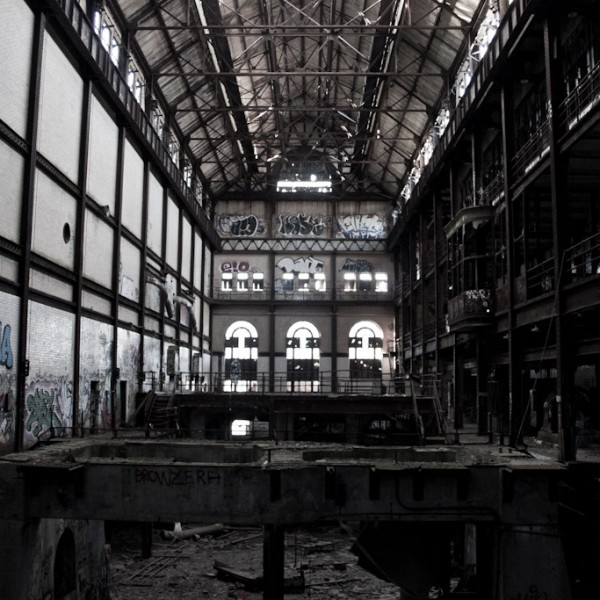
Miru Kim is a New York based artist who is famous for doing urban exploration in the nude (which she explains in this TED video). I remember the first time I saw her work was right after I explored the former Revere Sugar Factory in Red Hook, Brooklyn. I saw the nude pics of her on LTV and thought it was pretty dumb at the time but now that I’ve seen the result and understand what she was trying to do I’m kind of in awe. I’ve seen a lot of urban exploration pictures but hers are just on another level, precisely because she creates this character for them. Most urbex (including mine) is more of a way to document these great places. She goes to the next level and I have to give her mad props for it.

Market Hotel Pics

Saturday, February 21st, 2009

Went to the ToddP line up last night of Soft Circle, Teengirl Fantasy, These Are Powers, and Telepathe. I wasn’t a big fan of TAP until I saw them. They have a real primal beat to them that can only be experienced live. Telepathe I have seen once before and they sound better when they have full control over their beats, rather than singing to a prerecorded track.

title1

title2

21st Century City: A New Geography

Wednesday, February 18th, 2009

There is a great article in the March 2009 edition of The Atlantic by Richard Florida entitled “How the Crash Will Reshape America“. The article looks at how certain cities, notably New York, Charlotte, Detroit, and Las Vegas, have been shaped by the development patterns of the last 50 years and where the cities could be heading. There has been much talk of late about how this current economic crisis will change the socio-economic face of the globe. Most of this article deals with how these cities will be affected visa-vi their major employment sectors (for example, New York hasn’t been hit as hard by losing so many jobs in the financial sector as smaller cities which rely more on finance since finance only makes up about 8% of NYC’s economy).

Listening to politicians and economists talk about the current crisis it is easy to see that most of them don’t get what is really going on. Most of them want to get back to the status quo of the last 20 years. Unfortunately that status quo evaporated in a blink of an eye, caused mainly by the fact that most of the development policies of this country from the last 50 years created an over inflated bubble that was built on the unsustainable idea of continued growth in the housing sector. As a real estate agent once told me, “Not everyone should own a house.” But the politicians needed to fuel that dream to get votes. Obama can only do so much when he is up against a congress of delusional egotists clinging on desperately to only what gets them re-elected.


American Grandstand – Bank Hearings

But what really got my eye was how Florida tied in Geography and Urban Planning to all this.

If there is one constant in the history of capitalist development, it is the ever-more-intensive use of space. Today, we need to begin making smarter use of both our urban spaces and the suburban rings that surround them—packing in more people, more affordably, while at the same time improving their quality of life. That means liberal zoning and building codes within cities to allow more residential development, more mixed-use development in suburbs and cities alike, the in-filling of suburban cores near rail links, new investment in rail, and congestion pricing for travel on our roads. Not everyone wants to live in city centers, and the suburbs are not about to disappear. But we can do a much better job of connecting suburbs to cities and to each other, and allowing regions to grow bigger and denser without losing their velocity.

The 21st century has just begun and already we are getting primed for a radical shift in the basic fabric of our society. Some changes will be fast and sudden (such as this economic crisis) and other will take a long time, probably an entire generation, to mature. As Florida says, cities are not going anywhere, but it will be interesting to see what happens to some Sun Belt cities in the next 50 years. Will Phoenix and Las Vegas be the new Detroit? Will the hundreds of acres of unsold homes decay and return to nature while the central cities that once spread out for forever shrink and condense? Given the history of redevelopment in places like Buffalo and Detroit it wouldn’t be surprising if the leaders of these newly decaying cities try the same tired redevelopment schemes that Rust Belt towns tried in the 1980s, most of which failed miserably.

The cities that will win and prosper in the 21st century will be the ones that see this economic crisis as a new beginning, a chance to throw out now obsolete building patterns of the 20th century and focus on planting the seeds for economic engines of the 21st. Cities do not need to grow outwards anymore, though there will still be an aversion to tall buildings in many places. The key is balance, a particular city needs to find out what densities work for it and lay the groundwork for rebuilding neighborhoods that are places rather than faceless subdivisions. Many inner cities are still bombed out moonscapes that need serious investment. People moved to the suburbs for space and in leaving the cities they created space by letting their old neighborhoods decay. These are the areas that need cultivation the most, the old rotting infrastructure should be torn down and new schools and roads and parks need to be built, but only where they need to be built.

Some places, such as suburban Phoenix don’t need new roads and schools to attract people. If the future of Sun Belt cities is anything like Rust Belt cities then the opposite approach is needed. Cities need to know when and how to contract, not grow. Drive from Albany, NY to Detroit and all you will see is mile after mile of depression. The cities you pass left their glory periods long ago and while it was worth while to try redevelopment, these places need to come out of their denial; they are not coming back. The land in these cities could be better used as parks or even urban farming rather than trying to build a new casino or convention center. Since most of these communities are poor to the level of 3rd world standards urban farming would be a fantastic way to get their citizens much needed fresh food while at the same time creating sustainable jobs.

This economic crisis is just the beginning of the rebirth of the American city.

Music: Adventure

Thursday, October 23rd, 2008

Some of my most recent favorite acts have been coming out of Baltimore, including Ponytail and Dan Deacon. Adventure(Benny Boeldt) also hails from Wham City and is one of the better 8bit musicians I’ve heard. Maybe you just needed to grow up playing Nintendo, Atari, and Sega (Hey kids, this old man remembers time before PlayStation) but I find this music really interesting. Any artist who can limit themselves it terms of sounds and still make something new and interesting ranks high in my book. As I write this Adventure just finished playing over at Todd P’s not-CMJ music thing over at Continental Army Plaza in Williamsburg, Brooklyn but unfortunately I didn’t make it over there.

Adventure – Battle Cat

Audio clip: Adobe Flash Player (version 9 or above) is required to play this audio clip. Download the latest version here. You also need to have JavaScript enabled in your browser.

Adventure – Adventure (2008) is available on Carpark Records.