New MTA Service For Cheap

Wednesday, August 5th, 2009

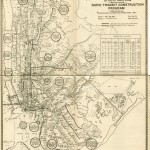
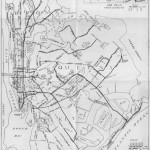
Mayor Mike Bloomberg announced plans yesterday for the MTA to improve service to subways, trains, roads, and ferries. Obviously a political stunt for his reelection, they were still interesting and through provoking ideas. Two specific ideas were to extend the V train, which currently terminates at 2nd Ave/Lower East Side, into Brooklyn (I haven’t seen where exactly he is proposing to extend it to) and for express F train service in Brooklyn. I can only assume that Bloomberg proposes to extend the V along the Culver Line to offset any lost F service, but this is too transparent, even for a politician, since the Culver Viaduct will be under reconstruction until 2012 and unable to support any express service.

But taking a step back, one realizes that there are miles of unused subway tracks that could be used for new service or part-time (i.e. rush hour) service all throughout the system. While expanding service along the Culver Line is a fantastic idea (not to mention much needed), why stop there? Just this past June the MTA experimented with express 4 train service in the Bronx at rush hour. The results of that program have not been made public but if it proved successful it could open the door for much improved service across the city that would not cost too much more to the cash strapped MTA.

F Express to Coney IslandF Express to Coney Island

On the table already, the F Express would, for now, only serve Brooklyn south of Church Ave, stopping at 18th Ave, Kings Highway, Ave X, Van Sicklen Ave, W.8th St, and finally Stillwell Ave. Due to there being only a single express track service would be only at rush hour, towards the city in the AM and towards Brooklyn in the PM.

Because of reconstruction on the Culver Viaduct the double track express track from Bergen St to Church Ave will not be available to use. One reconstruction is complete, however, there could be more permanent F Express service, with stops at Bergen St (which would have to be rebuilt) and 7th Ave.

vlocalV Local to Metropolitan Ave

In 1968 the MTA opened what was known as the Chrystie Street Connection where a new subway tunnel was built to connect the IND 6th Ave line with the Manhattan Bridge (allowing the B and D lines to travel to Coney Island). A second part of this connection was another tunnel that is now unused which connects the IND 6th Ave line to the BMT Jamaica line over the Williamsburg Bridge. For a short time in the late 1960s there was service from Broadway Junction to 57th St/6th Ave, known as the K line. Due to the depopulation of the areas this new line served at the time, the line was ended after just 10 years of service.

With these areas now seeing new waves of immigrants and then artists (read: gentrification) the neighborhoods along the JMZ have seen an increase in ridership which will most likely continue. Right now the area is only served by a new trains, the J, the M (which is cut back to Myrtle Ave at night), the Z (which may or may not be cut entirely), and the L (which is becoming more crowded by the day). To better serve this growing area the V Local should be rerouted through the unused section of tunnel to replace the M, which would either be eliminated or cut back to part-time service (even more so). The V would terminate at Metropolitan Ave in Queens

wexpressW Express to Astoria, Bay Parkway

In the 1980s there was rush hour service along the express track from Astoria Blvd to Queens Plaza along the BMT Astoria Line (now the N/W). With the recent and steady influx of new residents and housing construction that continues despite the recession, the area would be better served with rush hour W Express service.

On the other side of the line, the W currently terminates at Whitehall St. The W would then be extended to Bay Parkway in Bensonhurst and would run along the single express track, making stops at 9th Ave and 62nd St as well. The service would run only at rush hour. The part-time M service would continue running local, as is.

Miru Kim at TED

Wednesday, March 4th, 2009

Miru Kim is a New York based artist who is famous for doing urban exploration in the nude (which she explains in this TED video). I remember the first time I saw her work was right after I explored the former Revere Sugar Factory in Red Hook, Brooklyn. I saw the nude pics of her on LTV and thought it was pretty dumb at the time but now that I’ve seen the result and understand what she was trying to do I’m kind of in awe. I’ve seen a lot of urban exploration pictures but hers are just on another level, precisely because she creates this character for them. Most urbex (including mine) is more of a way to document these great places. She goes to the next level and I have to give her mad props for it.

Unbuilt Robert Moses Highway Maps

Thursday, February 26th, 2009

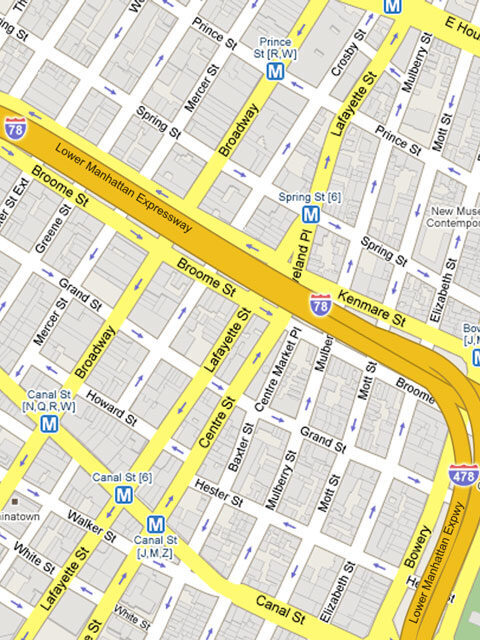
Lower Manhattan Expressway

Mid Manhattan Expressway

This is something I’ve been wanting to do for a long time but didn’t know how to start. I present my Google Maps version of the proposed Lower Manhattan Expressway and Mid Manhattan Expressways. (I didn’t know how to draw maps to look like Google Maps but it’s pretty easy.) Now there have been maps showing these proposed highways before (they are included in my Unbuilt Highways Map of NYC) but the point of doing it up to look like a Google Map was to put these highways in a modern context (also I’m sure there are plenty of people who didn’t even know about these). We have become so accustomed to viewing the world through Google Maps (or some other online mapping software) that I feel like these maps are starting to shape our view point of the city.

rmoses

Robert Moses, Undated (1930s?)

A map, after all, is a representation of reality with certain things omitted (or in this case, added). As mapping software becomes even more ubiquitous now that they are in the palm of our hands (Blackberrys, iPhones, etc), I think it will become all too easy for people to just accept what they see as reality. This is a dangerous prospect but one I think can be taken advantage of when trying to communicate certain information, such as what a neighborhood you know pretty well would look like with an elevated highway slammed through it. This was true for me, at least, while I was making these; Hand erasing buildings through SoHo, TriBeCa, and the LES was an eery experience as I tried to imagine what these places would really look like if my brush was a bulldozer.

And thus I began to understand the failing of Robert Moses (well, this one anyway). He didn’t drive and lord knows he didn’t think much of these areas which he tossed off as “slums”.   There is a famous image of a young Moses standing in front of a map of the entire city (to the left).

What you need to be aware of when you are looking at a map is how it lies to you; it is a seductress. You think because it represents reality you can better understand reality, which is true only to a point. But when combined with the power and ambition of Robert Moses the maps seduction warped him and let him think that a line across the map represented far less chaos and destruction than he perceived. Adjusting lines on a map is easy and because a map is a visual design adjusting lines seems like a good way to clean up the map. But the lines on a map hide the fact that they represent something real, a street that needs to be moved, houses that need to be knocked down, families and businesses that need to be kicked out. I’m not saying that Moses wasn’t aware of these things, in fact he was keenly aware. But it was so easy and sexy to clean up the map that he was willing to do whatever it took to draw his maps to be permanent.

Urban Exploration New York City 2009 Calendar

Monday, December 1st, 2008

Just in time for Christmas, the 2009 Urban Exploration New York City calendar is now available. Featuring images from the Greenpoint Terminal Warehouse, Revere Sugar Factory, High Line, and more!

Printed: 12 months, 13.5″ x 19″, coil binding, white interior paper (100# weight), full-color interior ink, $29.99.

Click the image or click here to purchase.

The Old Elevated Subway Lines of New York City

Monday, November 3rd, 2008

Using info from NYCSubway.org I threw together this Google Map of what the old Els looked like in NYC. Some were demolished (all the ones in Manhattan) but many of the Els in Brooklyn were incorporated into the subway system (though many were demolished as well. I’m gonna put this on the Subway System Maps page.


View Larger Map