Personal Rapid Transit (is stupid)
Tuesday, January 5th, 2010
PRT Cars in Minority Report via beconfused.com
Before I rant on I want to make on caveat which is that light fixed-gruideway transit is excellent as a more affordable option for getting a few people from point A to point B, or Terminal A to Terminal B, since they are great for airports. But this isn’t PRT in the sense I’m talking about it.
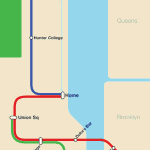
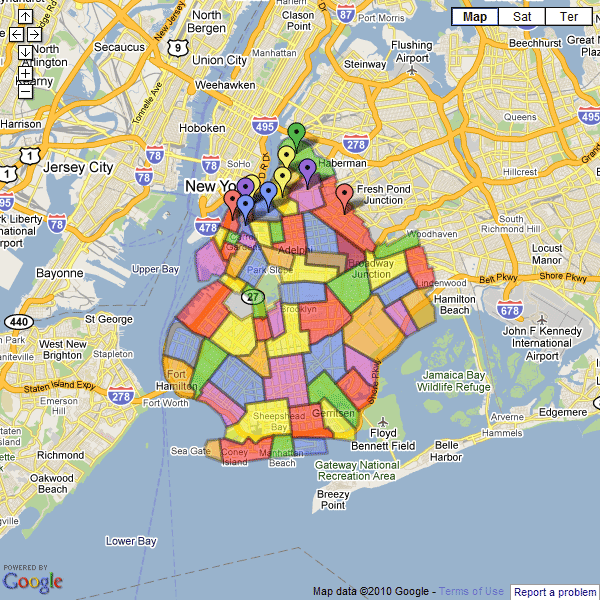
What got me thinking about this subject was the realization that over the course of a month I really only make a few different journeys. I decided to draw a map of these places and once I did I realized that I could connect them by way of (as my mind works) a subway, or PRT, system. Since most of my journeys are from my home to work, a friends place, or for afterhours fun (such is the life of a 25 year old male); mapping my routes is pretty simple. I also included a “commuter rail” line back to Boston when I want to visit my friends and relatives (cuz, you know, if I’m building my own personal subway, why not?) Also, now that you all know where I usually go, please don’t stalk me now.The idea is simple: Take the efficiency of mass transit and combine it with the rugged individualism of the American spirit. PRT systems are usually based on the idea that while the automobile is great for getting one or a few people from point A to point B, when millions of automobiles all try to get to different point As and point Bs that the current system of roads breaks down. The answer is always some sort of fixed tramway system where everyone has their own vehicle which will be driven automatically so traffic will become a thing of the past (oh traffic, you eternal evil!) The more advanced systems have the ability of allowing a vehicle to attach and detach from the fixed system and be driven along conventional roads. This feature would be beneficial since it would free people from only being able to go where the system existed.

PRT on a fixed-guideway via LightRailNow.org
PRT is a laughably complex system. Oh, computers can handle the traffic! People, computers are boxes of metal and plastic that only do something when instructed by a human. What this means is no matter what system we build it will still be at the hands of a person (and given how technology progresses, fewer and fewer persons). Another major problem with such a system (and in my opinion traffic engineering in general) is that it strives to take a large number of individuals, all doing something slightly different, and boil them down to a number. We are not numbers (fight the system yo!) A traffic engineer will look at a road with cars on it and only see the cars, the lanes, and the number of cars per hour in those lanes. He doesn’t see the people and because of this he doesn’t design the roads for the way people actually use them.
People don’t like to wait. People don’t understand numbers the way an engineer does. Think of the age old question of what weighs more, a pound(lbs) of feathers or a pound of lead? How many people would say lead without missing a beat (or after thinking about it for a while)? This issue pertains to transportation in a key way; people don’t like to not be moving. If you are waiting on a train platform for 10 min and then on a train for another 10 min it feels like much longer than 20 min than if you were in a car driving, constantly moving but at a slower speed, the same distance taking the same time. What this means for PRT is that all those little pods moving at the same speed will, by the numbers, make traveling more efficient and cut travel times. But people don’t think about the numbers, no. Imagine you are in one of those pods trying to get your kid to school or to work. In the pictures they show people relaxing as they are whisked to their destination. But isn’t that the promise every technology makes, that your life will be simpler and you will have more free time? Has that ever been the case? What do we do with the free time but think of more work to do. People would hate waiting in line, not being able to have control of where they are going. It works for theme parks because people are there to go on the ride. But back in their real world they very much need to control where they are going.When I hear someone mention Personal Rapid Transit all I think of is, “We already got cars!”